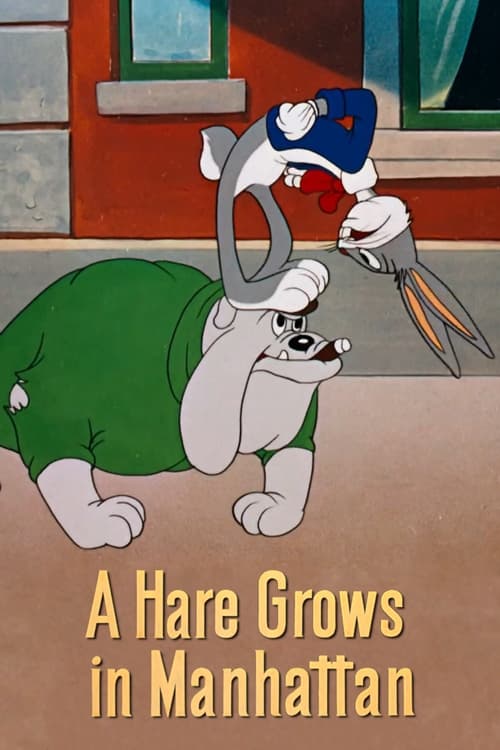
A Hare Grows in Manhattan (1947)
A Hare Grows in Manhattan (1947), directed by Friz Freleng, starring Mel Blanc and Bea Benaderet.
score
Synopsis
Bugs Bunny relates his early life in the Manhattan tenements and spotlights his encounter with a gang of canine toughs.
- Friz FrelengDirector
- Treg BrownEditing
- Edward SelzerProducer
- Carl W. StallingOriginal music
About the film
A Hare Grows In Manhattan is a Warner Bros. cartoon in the Merrie Melodies series, released on March 22, 1947. Directed by I. Freleng, the short features Bugs Bunny.
Read the full article (5k characters)
A Hare Grows In Manhattan is a Warner Bros. cartoon in the Merrie Melodies series, released on March 22, 1947. Directed by I. Freleng, the short features Bugs Bunny.
Plot
Hollywood gossip columnist Lola Beverly engages Bugs Bunny in a fictionalized biographical account. Bugs narrates his purported upbringing on the Lower East Side of Manhattan, illustrated through tap-dancing sequences and renditions of period songs.
Central is Bugs' recurrent encounters with a street gang of stray dogs, led by a dim-witted bulldog resembling Hector. The narrative unfolds amidst recognizable New York City landmarks, including the Automat and a stylized rendition of the Stork Club. As Bugs navigates the urban landscape, he employs humorous tactics to evade the pursuing canines.
Bugs thinks he has dispatched the dogs, saying "That's thirty for today!" He goes back to his tap-dancing and singing, and suddenly finds himself in a blind alley next to a newsstand. The gang of dogs reappears and marches in on Bugs menacingly. Enraged, Bugs grabs a book and threatens to hit them with it in his "last stand". The dogs' eyes open wide when they see the book, and they turn around and race to, and across, the Brooklyn Bridge. The puzzled Bugs looks at the book and sees that it is the novel A Tree Grows in Brooklyn.
Bugs says to himself, in a rare quiet and reflective moment, "Ya know, maybe I oughta read dis t'ing!" As the underscore reprises an instrumental bar of "Rosie O'Grady", Bugs walks away toward the city's skyscrapers, while reading the book and humming along.
Voice cast and additional crew
Mel Blanc voices Bugs Bunny, Spike
Frances Baruch voices Lola Beverly
Tedd Pierce voices Tough Gray Dog
Other Tough Dogs voiced by Michael Maltese
Film Edited by Treg Brown
Uncredited Orchestration by Milt Franklyn
Production notes
The short was originally based on a short autobiographical piece of the same name that was published in the December issue of Coronet magazine in 1945. In the autobiography, Bugs recounts his rise and only briefly mentions his days on the streets of Manhattan which he describes as "simple and carefree". He would spend his days throwing rocks at his pals, stealing carrots from local pushcarts, and dealing with thugs using his "rabbit punch" technique.
The story continues in which Bugs reveals that his name was given to him by his family for his funny antics. In time he would land a job at a place called the Palace where he would serve as the rabbit in the hat of the magician the Great Presto. Eventually he would leave for Hollywood, much to the sadness of his parents, to become a star. Which he boasted that he "arrived just in time to save the movies from the hams who was overrunning it".
Analysis
Andrea Most notes that this short has Bugs Bunny trying to escape his pursuers through constantly changing "costumes, voices, accents, and characters". She also points that throughout the Looney Tunes series, characters would change their "shape, size, character, gender, costume, and performance style" to either outwit or seduce others. She theorizes that the artists of Warner Bros. Cartoons, "mostly Jewish" in origin, were using a trope of transformation and escape which had deeper origins. She finds that many 20th-century comedies with Jewish creators share the theme of escaping through reinventing one's self.
This theme can be found in vaudeville comedy, where the comedians changed roles/identities with simple disguises. It can be found in Whoopee! (1928) and its film adaptation (1930), where Eddie Cantor's Jewish character transforms to "a Greek cook, a black errand boy, and an Indian chief". It can be found in the talent of Fanny Brice for "imitations". It can be found in Girl Crazy (1930), where Willie Howard transforms himself "to a woman, to a variety of famous performers..., to a western sheriff, to an Indian chief." One example is the film To Be or Not to Be (1942) where a mixed company of actors uses their skills in adopting roles to survive in Occupied Poland.
Home media
VHS - Starring Bugs Bunny
VHS - Bugs Bunny: Hollywood Legend
VHS - The Golden Age Of Looney Tunes Volume 7: Bugs Bunny by Each Director
Laserdisc - Bugs Bunny Classics: Special Collectors Edition
Laserdisc - The Golden Age Of Looney Tunes: Volume 1
DVD - Looney Tunes Golden Collection: Volume 3
Blu-ray/DVD - Looney Tunes Platinum Collection: Volume 3
Sources
Most, Andrea (2013), "The Birth of Theatrical Liberalism", Theatrical Liberalism: Jews and Popular Entertainment in America, New York University Press, ISBN 978-0-8147-5934-9
See also
List of Bugs Bunny cartoons
References
External links
A Hare Grows in Manhattan at IMDb
Text from A Hare Grows in Manhattan on Wikipedia, licensed CC BY-SA 4.0. https://en.wikipedia.org/wiki/A_Hare_Grows_in_Manhattan
Trivia
- It premiered on March 22, 1947, a Saturday.
- This film's quiz has 8 questions — enough to play more than once without repeats.
Production
- StudiosWarner Bros. Cartoons
- CountriesUnited States
- LanguagesSpanish, English
- StatusReleased
More about this film
Set in
- New York City
- Los Angeles
Cast
-
 Mel Blanc
Bugs Bunny / Spike / Dogs (voice)
Mel Blanc
Bugs Bunny / Spike / Dogs (voice) -
 Bea Benaderet
Lola Beverly (voice) (uncredited)
Bea Benaderet
Lola Beverly (voice) (uncredited) -
 Michael Maltese
Dog (voice) (uncredited)
Michael Maltese
Dog (voice) (uncredited) -
 Tedd Pierce
Dog (voice) (uncredited)
Tedd Pierce
Dog (voice) (uncredited)
Quiz about this movie
Questions from the whole catalogue.
Play nowIf you liked this one
-
O Super Lobo Mau
 6.5
6.5
-
Piquenique na Praia
 6.1
6.1
-
Ferdinando - O Touro
 6.7
6.7
-
Através do Espelho
 7.2
7.2
-
Cachorrinho & Cachorradas Animation from the 1940s
 6.7
6.7
-
Os Tempos Antigos
 6.4
6.4
-
Mickey e a Foca Animation from the 1940s
 6.8
6.8
-
O Capanga Animation from the 1940s
 7.5
7.5
-
Os Sobrinhos de Donald
 6.5
6.5
-
Cars Toon: As Grandes Historias de Mate
 7.0
7.0
-
Central da Festa
 6.8
6.8
-
Pateta: Basquete Que É Uma Bola Animation from the 1940s
 6.3
6.3
Tags
Crew
- Friz Freleng Director
- Treg Brown Editing
- Edward Selzer Producer
- Carl W. Stalling Original music
- Michael Maltese Story
- Tedd Pierce Story
Questions about this film
What is A Hare Grows in Manhattan about?
A Hare Grows in Manhattan: Bugs Bunny relates his early life in the Manhattan tenements and spotlights his encounter with a gang of canine toughs.
Who directed A Hare Grows in Manhattan?
A Hare Grows in Manhattan was directed by Friz Freleng in 1947.
Who stars in A Hare Grows in Manhattan?
The cast of A Hare Grows in Manhattan includes Mel Blanc, Bea Benaderet, Michael Maltese and Tedd Pierce.
How long is A Hare Grows in Manhattan?
A Hare Grows in Manhattan runs for 8 minutes, or 0h08.
Similar films
-
 7.3
7.3
Despicable Me
2010
-
 7.5
7.5
Who Framed Roger Rabbit
1988
-
 7.3
7.3
Minions: The Rise of Gru
2022
-
 7.5
7.5
The Bad Guys
2022
-
 6.3
6.3
Hoodwinked!
2005
-
 7.5
7.5
The Castle of Cagliostro
1979
-
 7.6
7.6
The Bad Guys 2
2025
-
 8.3
8.3
Toy Story 5
2026
-
 8.5
8.5
Pulp Fiction
1994
-
 7.6
7.6
Minions & Monsters
2026
-
 8.0
8.0
Toy Story
1995
-
 8.0
8.0
The Wolf of Wall Street
2013
Page updated on 09/15/2026.
Back to the catalogue