Tampopo (1985)
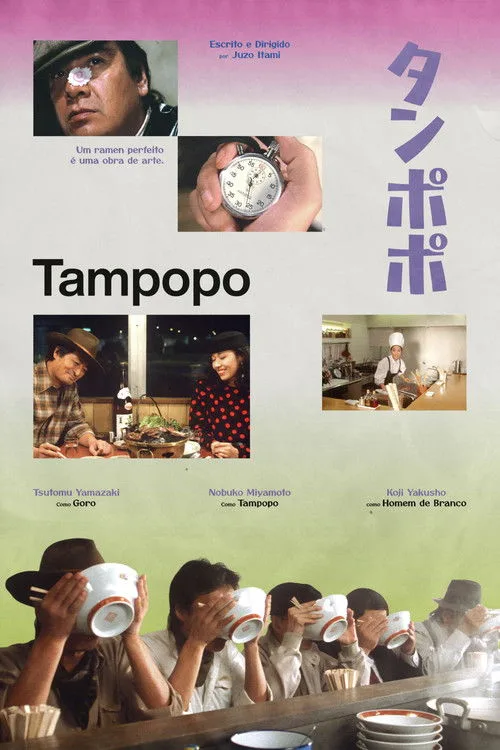
Tampopo (1985), directed by Jūzō Itami, starring Tsutomu Yamazaki and Nobuko Miyamoto.
score
The first Japanese Noodle Western.
Synopsis
In this humorous paean to the joys of food, a pair of truck drivers happen onto a decrepit roadside shop selling ramen noodles. The widowed owner, Tampopo, begs them to help her turn her establishment into a paragon of the "art of noodle-soup making". Interspersed are satirical vignettes about the importance of food to different aspects of human life.
What the catalogue says about this film
- Jūzō Itami and Tsutomu Yamazaki have worked together on 4 films in the catalogue
- The highest rated of Jūzō Itami's 3 films here, at 7.8
- Film 3 of 11 by Jūzō Itami in the catalogue
- Tsutomu Yamazaki and Nobuko Miyamoto share the screen in 5 films in the catalogue
Every comparison is within the CineQuiz catalogue, not cinema as a whole.
- 田村正毅Cinematography
- Jūzō ItamiDirector, Producer, Screenplay
- 鈴木晄Editing
- Yasushi TamaokiProducer
About the film
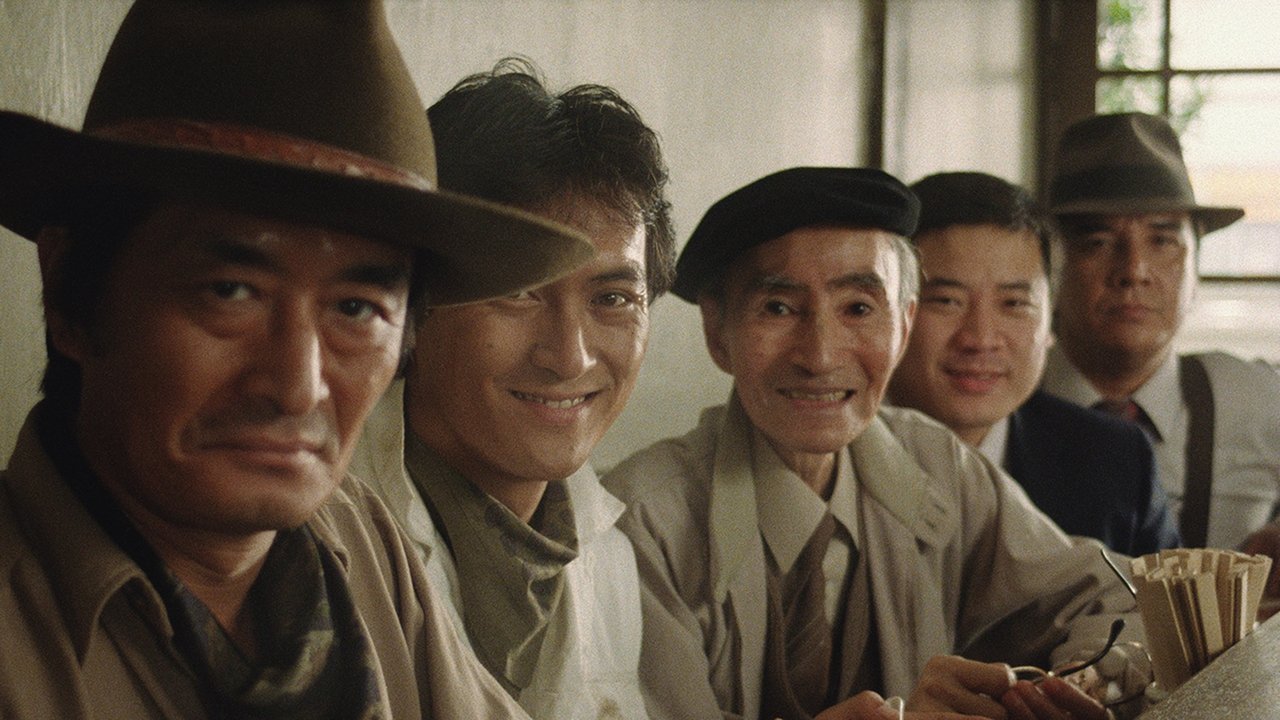
Tampopo (タンポポ, Tanpopo; literally "dandelion") is a 1985 Japanese comedy film written and directed by Juzo Itami, and starring Tsutomu Yamazaki, Nobuko Miyamoto, Kōji Yakusho, and Ken Watanabe. The publicity for the film calls it the first "ramen Western", a play on the term spaghetti Western.
Read the full article (10k characters)
Tampopo (タンポポ, Tanpopo; literally "dandelion") is a 1985 Japanese comedy film written and directed by Juzo Itami, and starring Tsutomu Yamazaki, Nobuko Miyamoto, Kōji Yakusho, and Ken Watanabe. The publicity for the film calls it the first "ramen Western", a play on the term spaghetti Western.
Plot
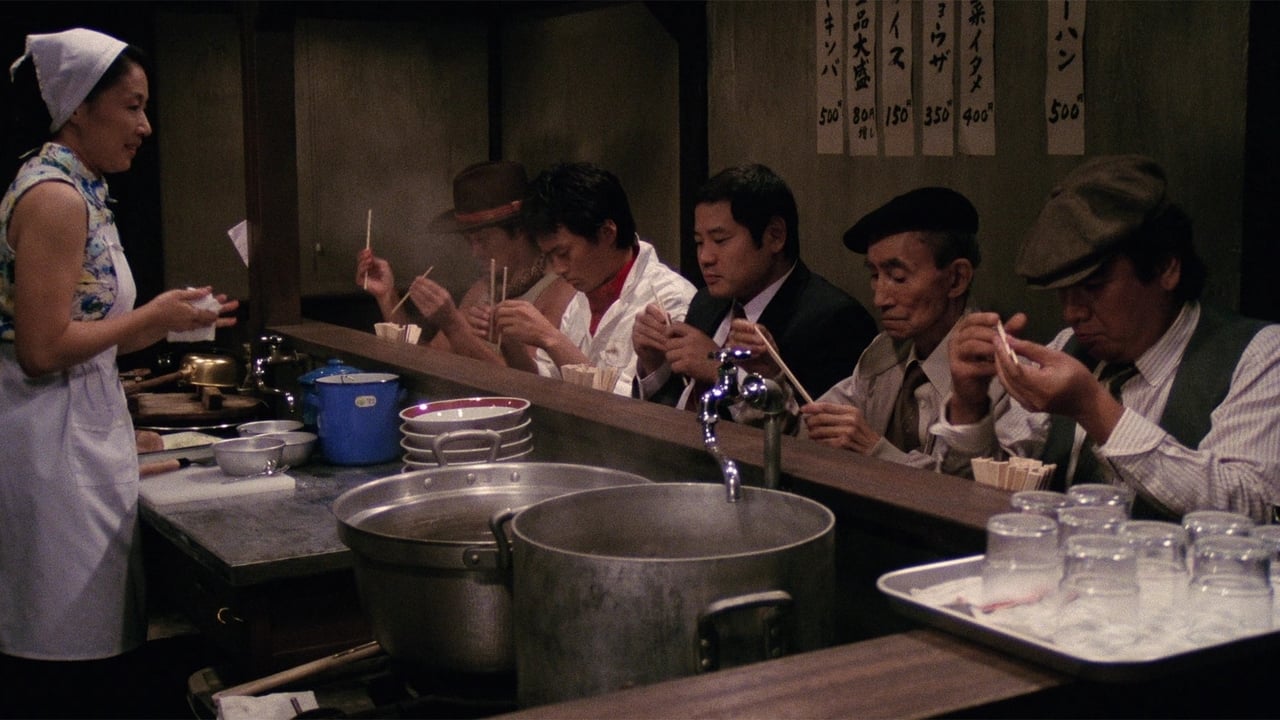
A pair of truck drivers, Gorō and his younger colleague Gun, stop at a nondescript roadside ramen noodle shop. Outside, Gorō rescues a boy who is being beaten by three schoolmates. The boy, Tabo, is the son of Tampopo, the widowed owner of the struggling ramen shop, Lai Lai. Inside, a customer called Pisuken harasses Tampopo, demanding that she sell the shop. Gorō suggests Pisuken be quiet so he can enjoy his meal, then provokes a physical confrontation. Gorō puts up a good fight but, outnumbered by Pisuken and his men, he is knocked out and awakens the next morning in Tampopo's home.
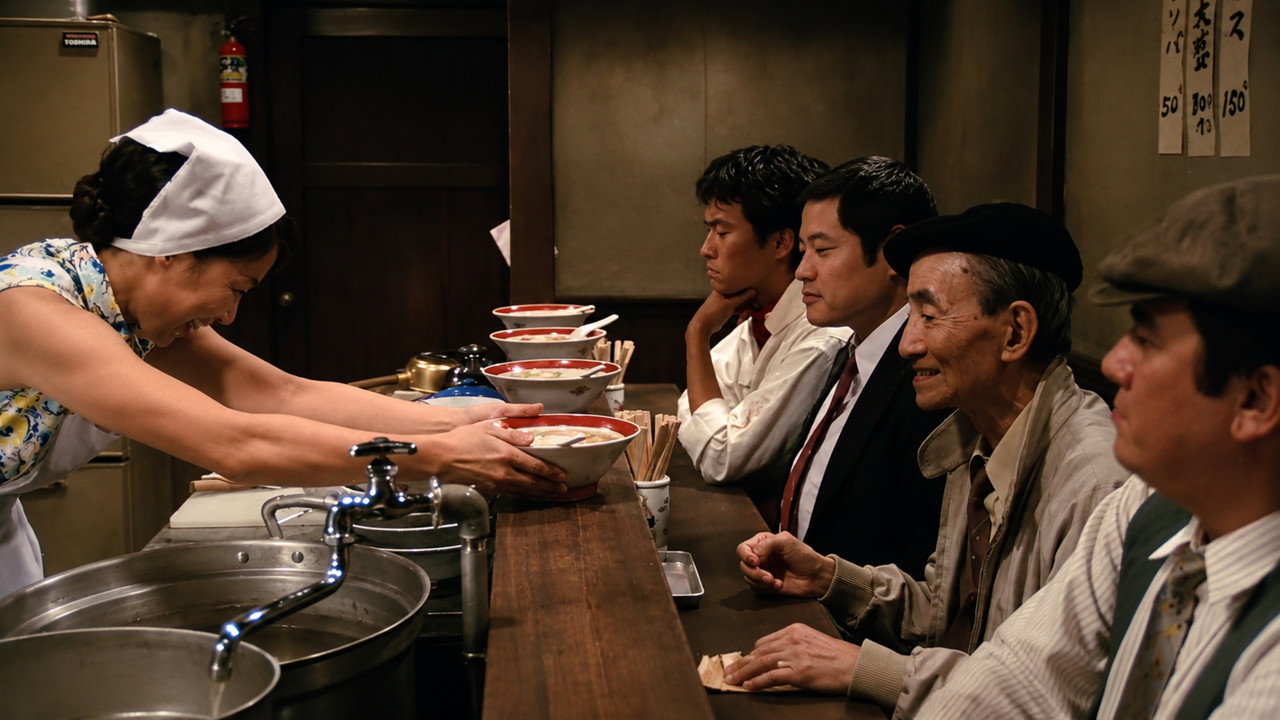
The next morning, she cooks breakfast for Gorō and Gun in her home kitchen and sends Tabo off to school. While eating breakfast, Tampopo asks for their opinion of her ramen, Gorō and Gun tell her it is "sincere, but lacks character." After Gorō gives her some advice, she asks him to become her teacher. They decide to turn her establishment into a paragon of the "art of noodle soup making". She and Gorō visit her competitors and he points out their strengths and weaknesses. Still struggling to perfect the broth, Gorō takes her to a homeless encampment to enlist the "old master". When they rescue a wealthy elderly man from choking on his food, the man lends her the services of his chauffeur Shohei, who has a masterly way with noodles. Gun and his friends give Tampopo a makeover as a modern proprietress. During the transition, the group agrees to change the restaurant's name from "Lai Lai" to "Tampopo".
Unrelated vignettes of other characters are also intercut within the main storyline:
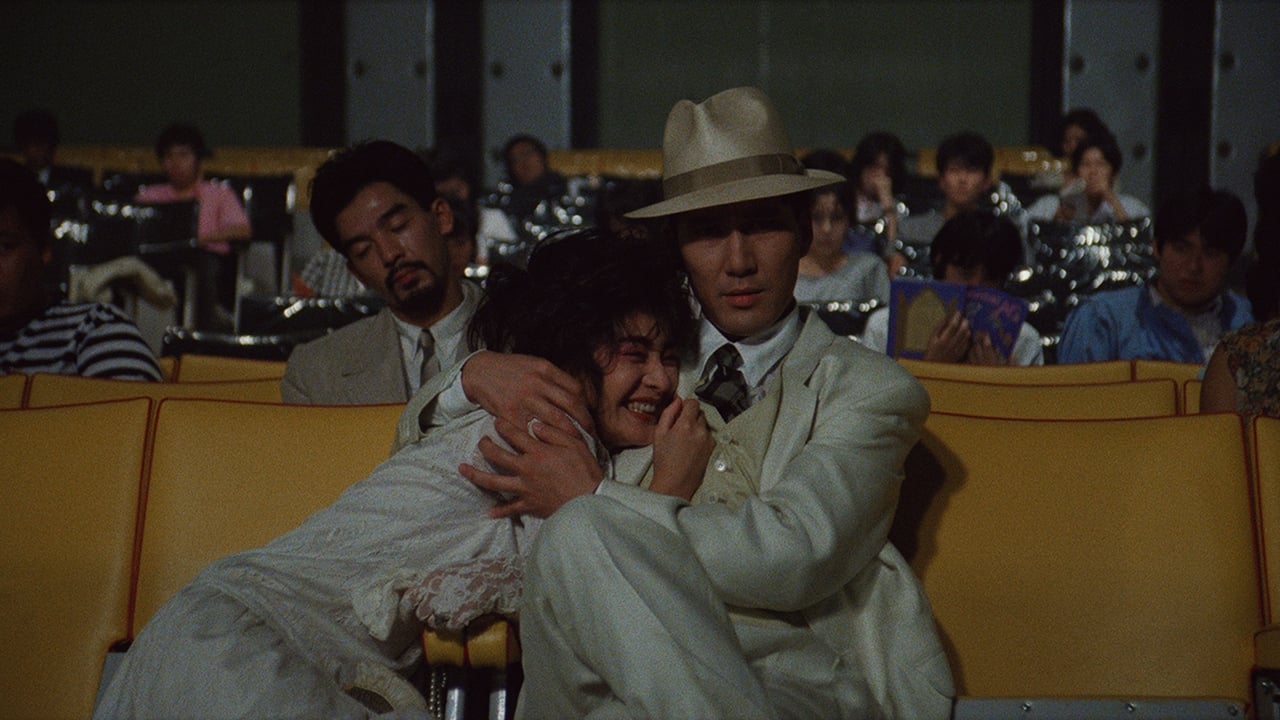
The film opens with "Man in White Suit" visiting a movie theater and breaking the fourth wall by addressing the viewing audience, warning them to keep quiet during the movie.
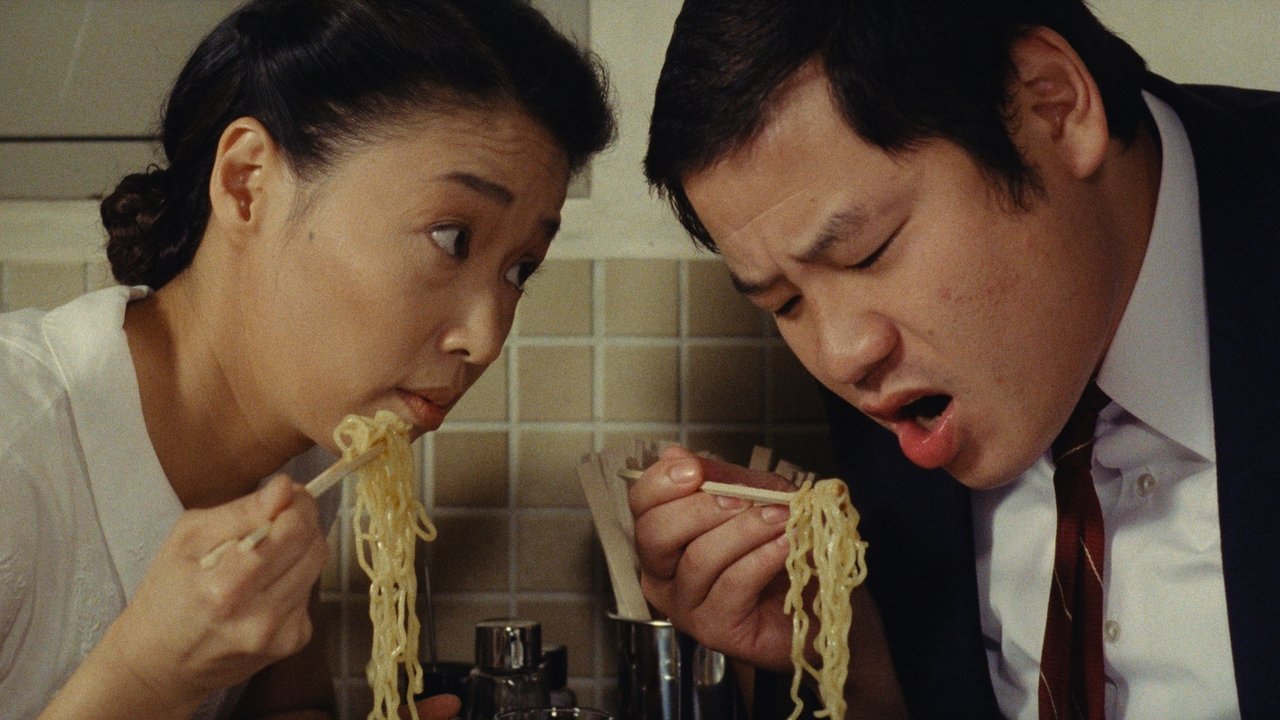
A "ramen noodle master" teaches his apprentice the proper traditional method for eating ramen noodle soup.
A group of business executives visit a French restaurant, but have no idea how to order and are upstaged by a surprisingly worldly subordinate.
A women's etiquette class on how to eat spaghetti silently in the European manner abruptly changes course upon observing a white man slurping his noodles.
A gentleman has a rotten tooth extracted, then eats ice cream afterwards, sharing with a young child whose mother forbids him to eat sweets.
A supermarket clerk catches an aged woman obsessed with squeezing food.
A con man uses an elaborate meal to lure a victim into an investment scam; the victim is himself a thief but is so taken by the meal that he fails to leave with the con man's wallet before being arrested.
A man and a teenage girl share an indirect kiss as she feeds him a fresh oyster from her palm.
A housewife rises from her deathbed to cook one last meal for her family, who mournfully eat to memorialize her.
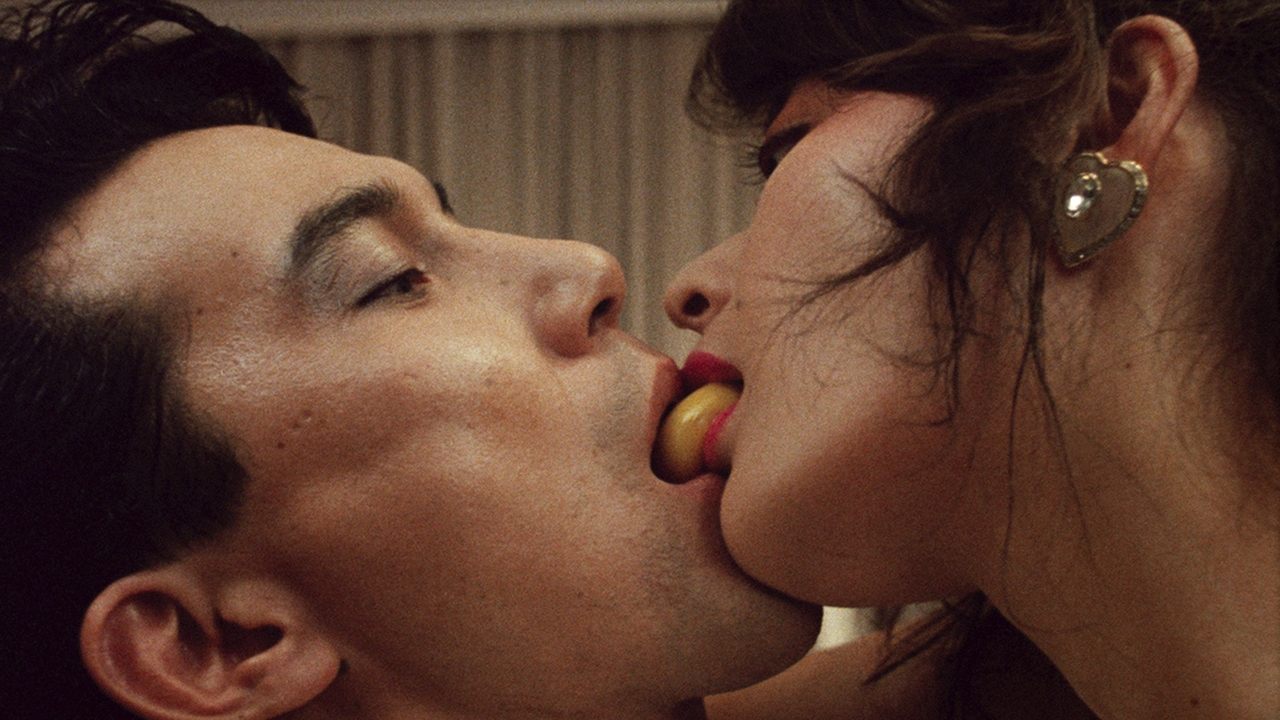
The Man in White Suit and his lover explore erotic ways to use food. Later in the film during a separate vignette, the man is ultimately shot several times by an unknown assailant, to his mistress's horror, though he is satisfied at the end of his life and hopes to see it play out like a film.
A woman on a park bench breastfeeds an infant.
Cast
Production
Following the success of The Funeral, Itami began writing Tampopo immediately after, drawing inspiration from Luis Buñuel's The Phantom of Liberty, and American westerns, Sergio Leone in particular. He then infused it with his own observations of ramen culture and its ability to democratize Japanese society, a subject he briefly explored in The Funeral.
Itami produced the film himself along with his wife and frequent collaborator, Nobuko Miyamoto, whom he cast in the titular role. By producing the property himself, it allowed him to quickly develop the script, begin principal photography, and release the film by November 1985.
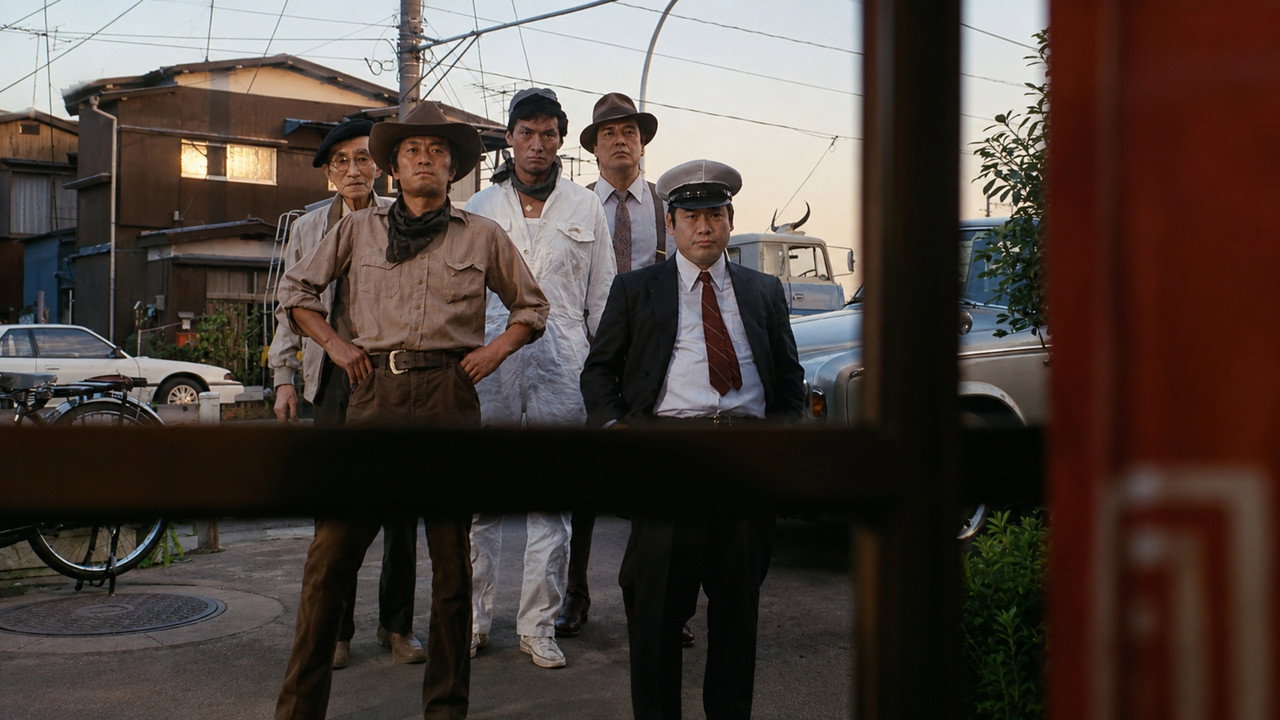
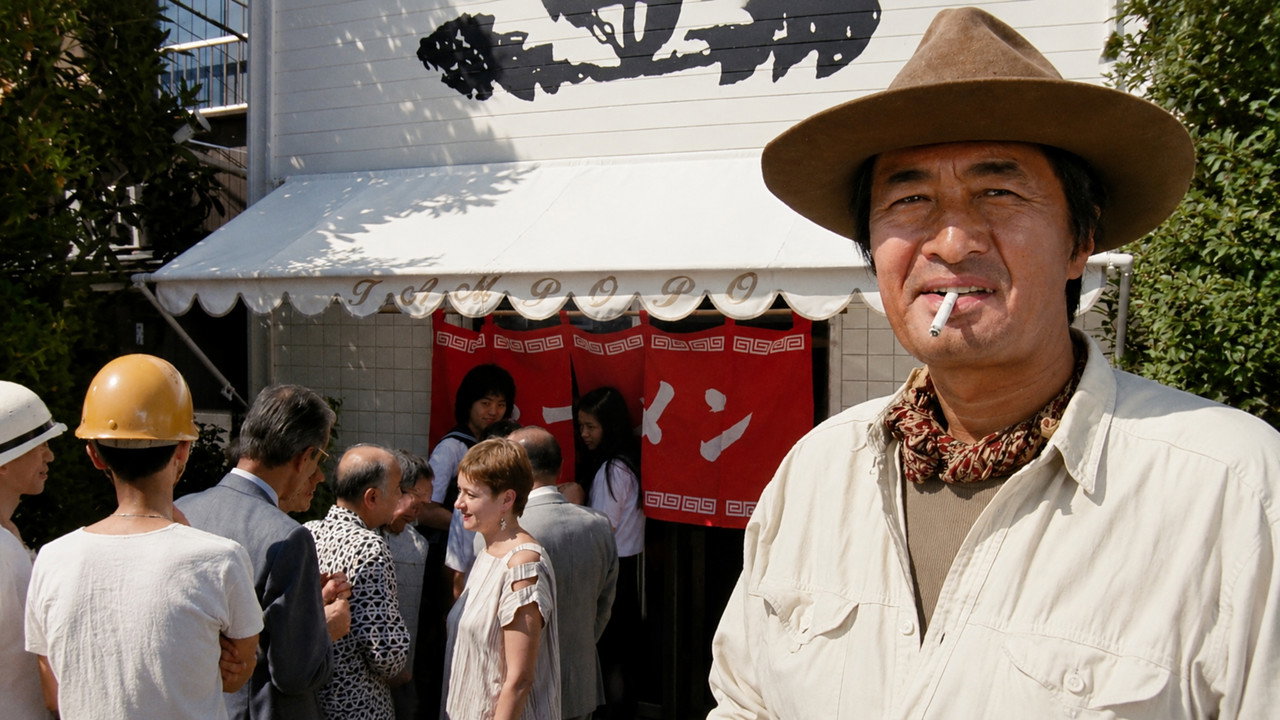
Filming for Tampopo primarily took place in Shibaura, Tokyo, then an industrial working class neighborhood built on reclaimed land just off Tokyo's Inner Circular Route, the main throughfare truck drivers use to get around greater Tokyo. Although the main restaurant interior was built on a stage, the restaurant exterior and road driven by Goro and Gun in their truck was filmed on Old Kaigan Road just off the Takahama bridge. Much of the film was shot at real locations with natural lighting in the cinéma vérité style by cinematographer Masaki Tamura, who created a vibrant portrayal of the 80s pre-bubble Tokyo before the development boom during which much of Shibaura's working class charm and the film's locations would disappear.
Due to the lack of major studio support, Itami relied on many non-professional local residents as talent, and the use of low tech equipment and jury rigged solutions to problems. Food Stylist Seiko Ogawa was hired not only to make bowl after perfect bowl of ramen, but also to serve as Miyamoto's ramen coach, and to act as the crew's caterer. In another vignette, a homeless man sneaks into a restaurant to cook Tampopo's son's omurice. The Nihonbashi restaurant Taimeiken's kitchen was used as the filming location, featuring then chef-owner Masaaki Modegi's unique inside-out style of omelette (Modegi also served as the hand model for the cooking close-up scenes), which has now become a popular way of serving omurice in Asia due in part to its popularity garnered from the film.
Release
Tampopo was released by Toho in Japan on November 23, 1985, where it received a modest box office, but initially found difficulty finding international distribution as it failed to meet The Funeral's popularity. It premiered internationally at the 1986 Toronto International Film Festival where it was well received by international critics and was picked up by New Yorker Films for US release in 1987, and has since become a cult classic.
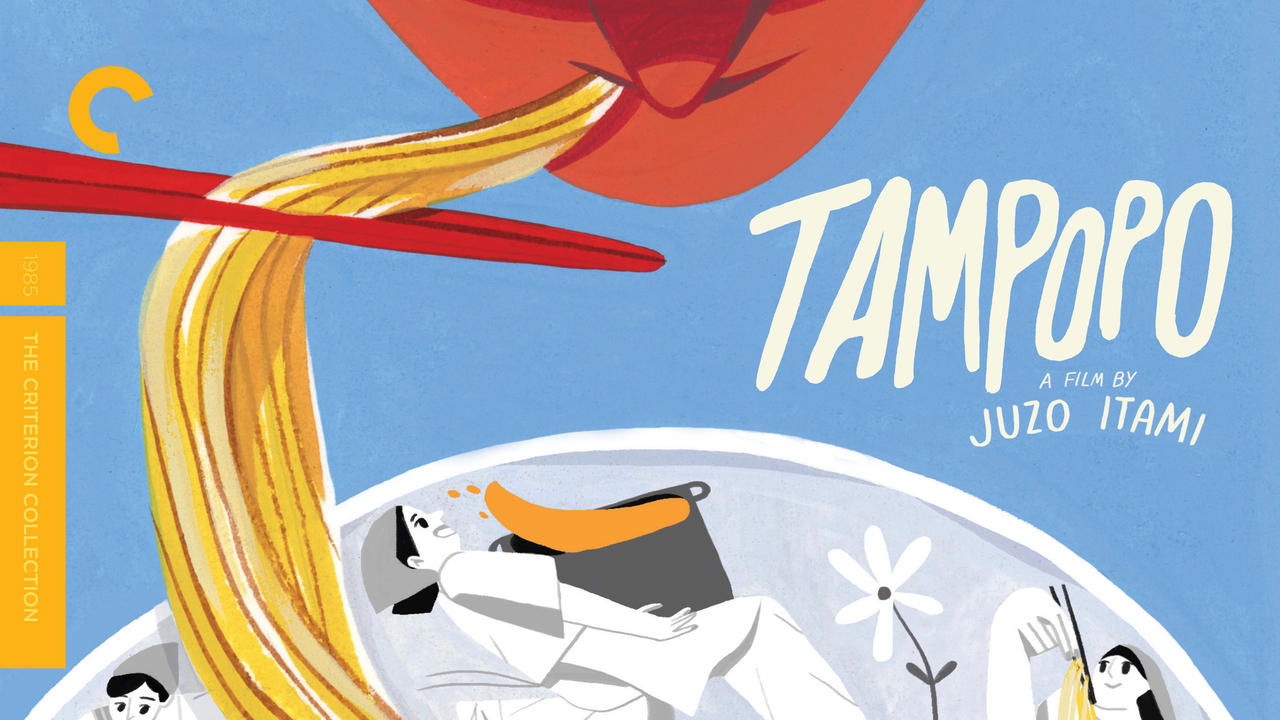
The Criterion Collection prepared a 4K restoration of Tampopo that was released in theaters and via Blu-ray in October 2016, and featured in several academic retrospectives.
Reception
Critical response
Roger Ebert gave the film four out of four stars, commenting that "Like the French comedies of Jacques Tati, it's a bemused meditation on human nature in which one humorous situation flows into another offhandedly, as if life were a series of smiles."
Hal Hinson of The Washington Post wrote, "The movie, which Itami calls a 'noodle Western,' is a rambunctious mixture of the bawdy and the sublime...Tampopo is perhaps the funniest movie about the connection between food and sex ever made."
Andrew Johnston writing in Time Out New York commented: "This film is his broadest comedy by far, and its principal subjects are those great global constants, food and sex. That, combined with the plot's sly evocation of movie Westerns, made it widely accessible to foreign audiences."
Vincent Canby provided a somewhat dissenting, though still positive, opinion in his New York Times review, stating, "Though it's not consistently funny... Tampopo is one of the more engaging films to be shown in this year's [New Directors/New Films] series... Mr. Itami often strains after comic effects that remain elusive. The most appealing thing about Tampopo is that he never stops trying."
Tampopo has received unanimous praise from critics, with a 100% approval rating and average score of 8.53/10 from Rotten Tomatoes, based on 52 reviews. The site's critical consensus states, "Thanks to director Juzo Itami's offbeat humor and sharp satirical edge, Tampopo is a funny, sexy, affectionate celebration of food and its broad influence on Japanese culture."
Accolades
Tampopo received two Japanese Academy Awards: Akira Suzuki for Best Editing, and Fumio Hashimoto for Best Sound. In the United States, it was nominated for an Independent Spirit Award for Best Foreign Film, and a National Society of Film Critics Award for Best Screenplay and Best Director.
Legacy
Tampopo has influenced many famous chefs including legendary chef and food writer Alice Waters, who has made the film required viewing for her kitchen staff, and her protégés Jerry Jaksich, Sam White, and Rayneil De Guzman who have not only made pilgrimages to Japan as a result, but opened their own ramen shop in 2013 as well.
Chef Ivan Orkin of Ivan Ramen also credits Tampopo as an inspiration for becoming a chef, as well as helping popularize ramen as more than just food for poor students in America.
Many film critics point to Tampopo as the originator of food porn. The film is also notable for dealing with food and sexuality together, a theme found in later films such as Like Water for Chocolate (1992), Chocolat (2000) and The Taste of Things (2024).
The 2008 American/Japanese movie The Ramen Girl, in which a girl played by Brittany Murphy learns how to cook ramen, contains many references to Tampopo, including a cameo by Tsutomu Yamazaki.
A number of ramen restaurants around the world have been named Tampopo, while the inside-out style of omelette featured in the film has become popular due to its dynamic presentation that lends itself to sharing on social media.
References
Bibliography
Further reading
Ashkenazi, Michael. "Food, Play, Business, and the Image of Japan in Itami Juzo's Tampopo". In Anne Bower, ed., Reel Food: Essays on Food and Film (Routledge, 2004). ISBN 978-1-135-87585-5
Keller, James R. Food, Film and Culture: A Genre Study (McFarland, 2006). ISBN 978-0-7864-2616-4
Lindenfeld, Laura and Parasecoli, Fabio. Feasting Our Eyes: Food Films and Cultural Identity in the United States (Columbia University Press, 2017). ISBN 978-0-231-54297-5
External links
Tampopo at IMDb
Tampopo at Rotten Tomatoes
Tampopo (in Japanese) at the Japanese Movie Database
Tampopo: Ramen for the People an essay by Willie Blackmore at the Criterion Collection
Text from Tampopo on Wikipedia, licensed CC BY-SA 4.0. https://en.wikipedia.org/wiki/Tampopo
Trivia
- The production budget was US$ 1.5 million.
- It premiered on November 23, 1985, a Saturday.
- It runs 1h55 — a typical feature length.
- Its original title is "タンポポ".
- This film's quiz has 13 questions — enough to play more than once without repeats.
Production
- StudiosNew Century Producers, Itami Productions
- CountriesJapan
- LanguagesJapanese
- BudgetUS$ 1,500,000
- StatusReleased
More about this film
Set in
- Tokyo
Videos
Photos
Cast
-
 Tsutomu Yamazaki
Goro
Tsutomu Yamazaki
Goro -
 Nobuko Miyamoto
Tampopo
Nobuko Miyamoto
Tampopo -
 Ken Watanabe
Gun
Ken Watanabe
Gun -
 Kōji Hashimoto
White Suit Man
Kōji Hashimoto
White Suit Man -
 Rikiya Yasuoka
Pisken
Rikiya Yasuoka
Pisken -
 Kinzō Sakura
Shohei
Kinzō Sakura
Shohei -
 Hyōe Enoki
Pisken's Henchman
Hyōe Enoki
Pisken's Henchman -
 Gō Awazu
Pisken's Henchman
Gō Awazu
Pisken's Henchman - Mario Abe Restaurant Owner
-
 Izumi Hara
Old Woman Pressing Camembert Cheese
Izumi Hara
Old Woman Pressing Camembert Cheese -
 Isao Hashizume
Waiter
Isao Hashizume
Waiter -
 Hisashi Igawa
Running Man
Hisashi Igawa
Running Man - Toshimune Kato Young Employee
-
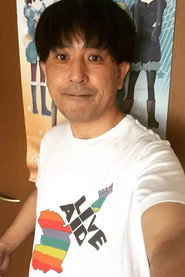 Kenso Kato
Hira
Kenso Kato
Hira -
 Yoshi Katō
Noodle-making Master
Yoshi Katō
Noodle-making Master -
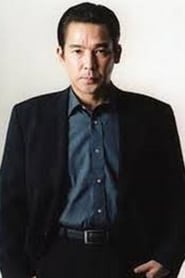 Yoshihiro Kato
Man in White Suit's Henchman
Yoshihiro Kato
Man in White Suit's Henchman -
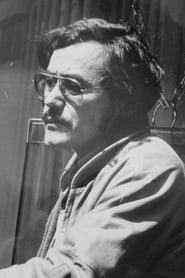 Toshiya Fujita
Man with Toothache
Toshiya Fujita
Man with Toothache -
 Fukumi Kuroda
Man in White Suit's Mistress
Fukumi Kuroda
Man in White Suit's Mistress -
 Nobuo Nakamura
Old Gentleman
Nobuo Nakamura
Old Gentleman -
 Mariko Okada
Spaghetti Teacher
Mariko Okada
Spaghetti Teacher
Quiz about this movie
Questions from the whole catalogue.
Play nowIf you liked this one
-
Loucas em Apuros
 6.5
6.5
-
A Vingança dos Nerds Comedy from the 1980s
 6.4
6.4
-
O Balconista
 7.4
7.4
-
Arizona Nunca Mais Comedy from the 1980s
 7.1
7.1
-
Eating Raoul Comedy from the 1980s
 6.5
6.5
-
Um Pequeno Favor
 6.6
6.6
-
Amante a Domicílio
 5.8
5.8
-
O Dono do Pedaço
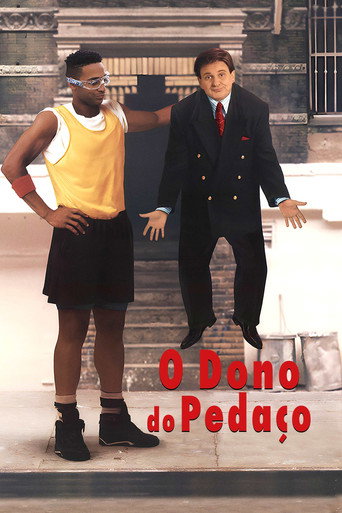 5.9
5.9
-
Fackham Hall
 6.7
6.7
-
Um Dia Daqueles
 6.7
6.7
-
Como Enlouquecer Seu Chefe
 7.4
7.4
-
Os Gatões - O Início
 6.2
6.2
Tags
Crew
- 田村正毅 Cinematography
- Jūzō Itami Director
- 鈴木晄 Editing
- Jūzō Itami Producer
- Yasushi Tamaoki Producer
- 細越省吾 Producer
- 村井邦彦 Original music
- Jūzō Itami Screenplay
Questions about this film
What is Tampopo about?
Tampopo: In this humorous paean to the joys of food, a pair of truck drivers happen onto a decrepit roadside shop selling ramen noodles. The widowed owner, Tampopo, begs them to help her turn her establishment into a paragon of the "art of noodle-soup making". Interspersed are satirical vignettes about the importance of food t…
Who directed Tampopo?
Tampopo was directed by Jūzō Itami in 1985.
Who stars in Tampopo?
The cast of Tampopo includes Tsutomu Yamazaki, Nobuko Miyamoto, Ken Watanabe, Kōji Hashimoto and Rikiya Yasuoka.
How long is Tampopo?
Tampopo runs for 115 minutes, or 1h55.
Similar films
 8.3
8.3
 8.5
8.5
 8.5
8.5
 7.6
7.6
 8.0
8.0
 7.6
7.6
 8.0
8.0
 8.5
8.5
 7.9
7.9
 7.9
7.9
 8.0
8.0
 8.3
8.3
Page updated on 09/08/2026.
Back to the catalogue