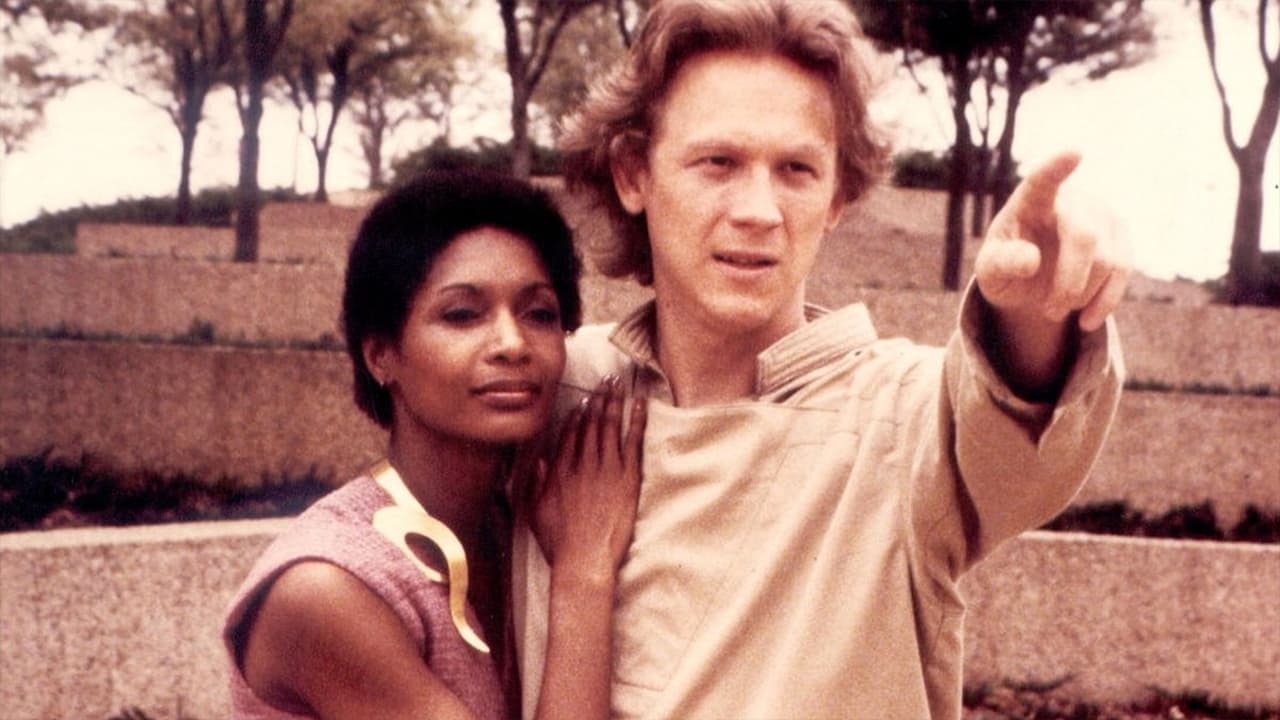
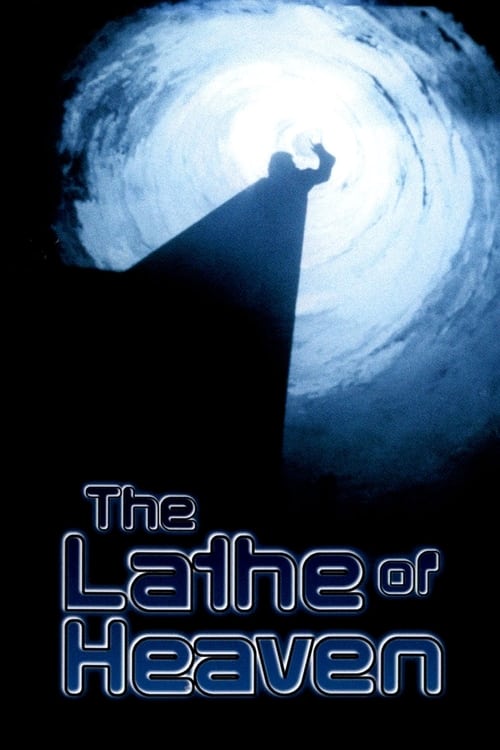
The Lathe of Heaven (1980)
The Lathe of Heaven (1980), directed by David R. Loxton, starring Bruce Davison and Peyton E. Park.
score
Ursula K. Le Guin's Science Fiction Masterpiece
Synopsis
George Orr, a man whose dreams can change waking reality, tries to suppress this unpredictable gift with drugs. Dr. Haber, an assigned psychiatrist, discovers the gift to be real and hypnotically induces Mr. Orr to change reality for the benefit of mankind --- with bizarre and frightening results.
- Robbie GreenbergCinematography
- David R. LoxtonDirector, Producer
- Fred BarzykDirector, Producer
- Dick BartlettEditing
About the film
The Lathe of Heaven is a 1980 film adaptation of the 1971 science fiction novel The Lathe of Heaven by Ursula K. Le Guin. It was produced in 1979 as part of New York City public television station WNET's Experimental TV Lab project, and directed by David Loxton and Fred Barzyk. Le Guin, by her own account, was involved in the casting, script planning, rewriting, and filming of the production.
The film stars Bruce Davison as protagonist George Orr, Kevin Conway as Dr. William Haber, and Margaret Avery as lawyer Heather LeLache.
Read the full article (13k characters)
The Lathe of Heaven is a 1980 film adaptation of the 1971 science fiction novel The Lathe of Heaven by Ursula K. Le Guin. It was produced in 1979 as part of New York City public television station WNET's Experimental TV Lab project, and directed by David Loxton and Fred Barzyk. Le Guin, by her own account, was involved in the casting, script planning, rewriting, and filming of the production.
The film stars Bruce Davison as protagonist George Orr, Kevin Conway as Dr. William Haber, and Margaret Avery as lawyer Heather LeLache.
Plot
In Portland, Oregon, in the near future, George Orr is charged with abuse of multiple prescription medications, which he was taking to keep himself from dreaming. Orr volunteers for psychiatric care to avoid prosecution, and is assigned to the care of licensed oneirologist William Haber. Orr's explanation of his drug abuse is incredible: He has known since age 17 that his dreams change reality, and tries to prevent himself from this "effective dreaming" because he fears their effects.
Haber initially considers Orr's fear as a delusional symptom of neurosis or psychosis, referring to him as "possibly an intelligent schizophrenic". The doctor puts Orr into a hypnotic trance while attached to the "Augmentor," a device he has invented for monitoring and enhancing, or augmenting, brainwaves during dreaming, to help with patient therapy. He encourages Orr to have an effective dream, recording his brain function all the while. The world changes slightly during this dream, and Haber realizes that Orr is telling the truth.
Haber begins to use Orr's effective dreams, first to create a prestigious, well-funded institute run by himself, then to attempt to solve various social problems. But these solutions unravel quickly: Haber suggests that Orr dream of an answer to overpopulation (resulting in a plague wiping out three-fourths of the human population), the end to all conflict on Earth (resulting in an alien invasion uniting mankind), and an end to racism (resulting in a world where everyone's skin is a uniform shade of gray).
Orr turns to lawyer Heather LeLache for help in getting out of his government-mandated treatments with Haber. LeLache doubts Orr's sanity, but agrees to help him, eventually becoming an ally. Orr falls in love with LeLache.
Only after several failed attempts to "make the world right" does Haber admit to Orr that he believes in Orr's power. Having used the Augmentor to record and analyze Orr's supremely complex dreaming brainwaves, Haber begins creating a machine that will allow him to have his own effective dreams, and remake reality directly.
As Haber continues to use Orr's dreams to create change in human society, Orr remembers a dream he experienced years ago, which is briefly portrayed at the opening of the film (and which, it turns out, is in fact reality): The world was destroyed in a nuclear war, and Orr was poisoned by radiation. In his dying moments, Orr dreamed a world where the war did not happen, resulting in the events of the film as we see them.
Haber enters the final version of his machine for directing dreams and learns this truth, driving him mad. Orr, who has joined him in the dream state, is able to stop Haber's nightmare before it destroys the world. The result is a reality that jumbles together elements of the different worlds that Haber created via Orr's dreams, but is relatively stable. Orr is heartbroken because the LeLache in this reality was never his close friend or lover.
As the film ends, Orr is working in an antique store run by an alien. LeLache comes in to browse. She has only a vague memory of him, but agrees to join him for lunch. They encounter Haber, in a wheelchair, on their way to lunch. Haber recognizes Orr, but cannot come out of his catatonia.
Cast
Bruce Davison as George Orr
Kevin Conway as Dr. William Haber
Margaret Avery as Heather LeLache
Niki Flacks as Penny Crouch
Peyton Park as Mannie Ahrens
Vandi Clark as Aunt Ethel
Jo Livingston as George's Father
Jane Roberts as Grandmother
Tom Matts as Grandfather
Frank Miller as Parole Officer
Joye Nash as Woman on Subway
Gena Sleete as Woman on Subway
Ben McKinley III as Orderly
R.A. Mihailoff as Orderly
Behind the scenes
Directors David Loxton and Fred Barzyk were pioneers in the early video art movement. They met in 1968 at WGBH TV in Boston and collaborated for over 20 years, until Loxton's death in the early 1990s. The first science fiction drama they created together was a 1972 film called Between Time and Timbuktu, based on the work of Kurt Vonnegut, Jr.
With a two-week shooting schedule, and a lean budget of about $250,000, Loxton and Barzyk had to get creative to effectively convey The Lathe of Heaven's deeper meanings and sometimes grand science fiction scenarios. In an interview in 2000, Barzyk said:
David and I had a unique working relationship. We were co-producers, co-directors. If you really cut it down, I would run the set, and David would run behind-the-scenes. But when it came to content and the actual physical structure of the set, we had equal input. The reason that was important, especially on Lathe, is that we had a very limited budget, and we were moving into science fiction ... and let's face it, some of Ursula's ideas were pretty big. I mean, how the hell do we possibly even begin to portray the attack of aliens or the wiping out of billions of people with the plague? What it came down to was, we had to find metaphors. We had to find things that didn't cost that much money and still led to maybe the same kind of emotional impact.
... Our special effects in Lathe were not done the way they were because that was necessarily the direction we wanted to go. It was the direction we had to go. We didn't have enough money to be able to do these things, so we were constantly trying to figure out ways in which we could shoot something in half a day and imply vast amounts of impressions to the audience. For example, when everyone gets wiped out by the plague, we came up with the idea of putting people around a table and just constantly circling the table and making them distorted and growing older to imply all those people being killed. That was partly because we couldn't think of any other way to do it within the constraints of our budget. But we were also influenced by video artists. There was one artist who had taken fishwire and wrapped his face, for example, and so I used a variation of that in this scene. We grabbed from the art director the dust and the smoke and the cobwebs, and in effect we wound up using some of David's English heritage with the candelabras and the rest, which kind of went back to Great Expectations.
The film was shot at locations in Dallas, Texas, and nearby Fort Worth rather than in Portland, Oregon. These included the Dallas City Hall, the Tandy Center Fort Worth, Hyatt Regency Dallas with its Reunion Tower, and a vacated Mobil Oil Building in Fort Worth. Le Guin, her husband, their fifteen-year-old son, and her husband's eighty-year-old Aunt Ruby appear as extras in a scene where Heather and George talk over lunch in a cafeteria.
According to a 1978 article in The New York Times, during the process of funding a prospective series focused on "speculative fiction, a category of fairly recent vintage applied to ... the most thoughtful and provocative works of science fiction ... [such as] Arthur C. Clarke, Frank Herbert, Kurt Vonnegut Jr., Anthony Burgess and Robert Heinlein," Le Guin was one of several authors whose novels were considered for adaptation: "The [$750,000] financing was awarded as the result of an earlier grant by [the Corporation for Public Broadcasting] to research and develop such a series. After much study with a team of consultants that included critics, authors, editors, publishers and professors, a list of candidates for the series was compiled, from which Miss LeGuin's novel was selected" to be the series pilot. In her essay on the making of the film, Le Guin was asked by Loxton to choose which novel. "I picked The Lathe of Heaven because it's the only one of my books that I ever enjoyed imagining as a film."
At the time this funding was given, it was thought the film would be shot in Portland, Oregon, where the story takes place.
Loxton and Barzyk hoped that Lathe would be the first production in a public television series exploring science fiction literature. They created one more telefilm together under this rubric, 1983's Overdrawn at the Memory Bank, based on a short story by John Varley.
Reception and awards
When it first aired in 1980, The Lathe of Heaven became one of the two highest-rated shows that season on PBS, drawing 10 percent of the audience in New York and 8 percent in Chicago, according to Nielsen ratings.
Michael E. Moore reviewed The Lathe of Heaven in Ares Magazine #1. Moore commented that "One hopes some producers who plan yet more clones of Star Wars will have watched Lathe and learned that science fiction does not consist solely of dogfights in space and cardboard heroes facing 'gee-whiz' challenges. The best science fiction, such as Lathe, examines humankind's place in the universe and the products and problems created by intelligence."
The Lathe of Heaven was nominated for a Hugo Award for Best Dramatic Presentation. The screenplay was nominated for a Writers Guild Award for writers Roger Swaybill and Diane English
In 1998, Entertainment Weekly magazine named the 1980 Lathe telefilm one of the top 100 greatest works of science fiction.
Of the 2000 re-release (see below), TV Guide wrote, "Unlike much current science fiction, it's driven by ideas rather than special effects, and Davison's subtle performance as George, who turns out to be a far tougher character than he at first appears, is a highlight." In Cinescape, a reviewer praised the film as
an instant classic ... a film of ideas rather than action ... [W]hile the minuscule budget didn't grant the filmmakers the grandeur of some of Le Guin's set pieces in the novel, such as the alien invasion or the melting of Portland, the film's strength comes from its performers and the suspenseful concepts in the writing.
Time magazine wrote:
Nineteen years before The Blair Witch Project, this classic sci-fi film showed that you can make an arresting fantasy with hardly more than the change under your couch cushions ... [S]ome of the no-budget effects haven't aged well--at one point the earth is visited by alien ships that look like electric hamburgers. The provocative exploration of consciousness, though, is priceless.
2000 re-release
After its initial broadcast in 1980, Lathe was occasionally shown over the next eight years. PBS' rights to rebroadcast the program expired in 1988. The Lathe of Heaven went on to become the most-requested program in PBS history.
Fans were critical of WNET's supposed "warehousing" of the film, but the budgetary barriers to rebroadcast were high. In a 2000 article, Joseph Basile, director of program rights and clearances for WNET, said, "'Lay people don't understand that to take a program out of mothballs, we have to pay for and clear rights with all participants in the program ... It's a difficult and time-consuming and expensive endeavor."
Basile also had to negotiate a special agreement with the composer of the film's score, and deal with the Beatles recording excerpted in the original soundtrack, "With a Little Help from My Friends", which is integral to a plot point in both the novel and the film. A cover version replaces the Beatles' own recording, "which would have taken too long to clear and cost 'an arm and a leg'."
Once rights issues were resolved, the film was cleaned up from two-inch Quadruplex videotape copies. In 2000, Lathe was finally rebroadcast and released to video and DVD. In addition to the film, this release features an interview with Ursula K. Le Guin by Bill Moyers, which initially aired along with the film's rebroadcast.
The back cover of the DVD notes, “The original film materials have been lost forever. A new digital master was created from the surviving 2″ tape and was then color corrected using state-of-the-art technology. Ghosting and darkening of the images may appear in some scenes. It is the best quality transfer possible of this important work using the only surviving materials.”
WNET has not said how much it cost to re-release Lathe, stating simply that it "wasn't cheap," and that hopefully royalties would help recoup the expense.
Pop culture impact
Bruce Davison guest-starred in a 1995 episode of the television show The Outer Limits titled "White Light Fever" which features a visual homage to Lathe: a "tunnel of blue light" effect very similar to a special effect used near the end of the film. (An image from this sequence is featured on the cover of both the mass market paperback edition of the novel that was issued with the film's premiere, and the 2000 video/DVD release).
The novel was again adapted as a telefilm by A&E Networks in 2002, titled Lathe of Heaven.
References
External links
Thirteen/WNET's The Lathe of Heaven web site (archived version)
Lathe production stills at Bruce Davison's Official web site
The Lathe of Heaven at IMDb
Text from The Lathe of Heaven (film) on Wikipedia, licensed CC BY-SA 4.0. https://en.wikipedia.org/wiki/The_Lathe_of_Heaven_(film)
Trivia
- It premiered on January 9, 1980, a Wednesday.
- It runs 1h45 — a typical feature length.
- This film's quiz has 13 questions — enough to play more than once without repeats.
Production
- StudiosThirteen, Taurus Film, PBS
- CountriesUnited States
- LanguagesEnglish
- StatusReleased
More about this film
Based on
- The Lathe of Heaven
Cast
-
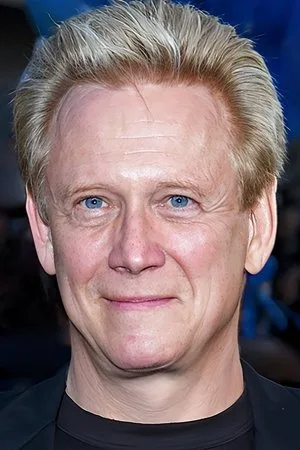 Bruce Davison
George Orr
Bruce Davison
George Orr - Peyton E. Park Mannie Ahrens
- Niki Flacks Penny Crouch
-
 Kevin Conway
Dr. William Haber
Kevin Conway
Dr. William Haber - Vandi Clark Aunt Ethel
- Bernedette Whitehead George's Mother
- Jo Livingston George's Father
- Jane Roberts Grandmother
- Tom Matts Grandfather
- Frank Miller Parole Officer
- Joye Nash Woman on Subway
- Gena Sleete Woman on Subway
-
 Margaret Avery
Heather LeLache
Margaret Avery
Heather LeLache - Ben McKinley III Orderly
-
 R.A. Mihailoff
Orderly
R.A. Mihailoff
Orderly - James Bodean Guard (uncredited)
- John Rainone The Grey Person (uncredited)
- Ben Stephenson Scientist (uncredited)
Quiz about this movie
Questions from the whole catalogue.
Play nowIf you liked this one
-
Battlestar Galactica: Razor
 7.2
7.2
-
O Homem Que Caiu na Terra
 6.5
6.5
-
Rage of Stars
 6.0
6.0
-
The Dead Zone
 7.5
7.5
-
Ben 10: Corrida Contra o Tempo
 5.8
5.8
-
2073
 6.7
6.7
-
Vesper
 6.3
6.3
-
O Vidente
 6.1
6.1
-
Ben 10: Invasão Alienígena
 6.2
6.2
-
Loop Infinito
 5.9
5.9
-
O Exterminador do Futuro Thriller from the 1980s
 7.7
7.7
-
Arquivo X: Eu Quero Acreditar
 5.9
5.9
Tags
Crew
- Robbie Greenberg Cinematography
- David R. Loxton Director
- Fred Barzyk Director
- Dick Bartlett Editing
- David R. Loxton Producer
- Fred Barzyk Producer
- Michael Small Original music
- Diane English Writer
- Roger Swaybill Writer
Questions about this film
What is The Lathe of Heaven about?
The Lathe of Heaven: George Orr, a man whose dreams can change waking reality, tries to suppress this unpredictable gift with drugs. Dr. Haber, an assigned psychiatrist, discovers the gift to be real and hypnotically induces Mr. Orr to change reality for the benefit of mankind --- with bizarre and frightening results.
Who directed The Lathe of Heaven?
The Lathe of Heaven was directed by David R. Loxton and Fred Barzyk in 1980.
Who stars in The Lathe of Heaven?
The cast of The Lathe of Heaven includes Bruce Davison, Peyton E. Park, Niki Flacks, Kevin Conway and Vandi Clark.
How long is The Lathe of Heaven?
The Lathe of Heaven runs for 105 minutes, or 1h45.
What is The Lathe of Heaven based on?
The Lathe of Heaven is based on The Lathe of Heaven.
Similar films
-
7.2
Battlestar Galactica: Razor
2007
-
 7.9
7.9
Death Note Relight 1: Visions of a God
2007
-
 6.9
6.9
Afro Samurai: Resurrection
2009
-
 7.5
7.5
Doctor Who: Planet of the Dead
2009
-
 7.6
7.6
Doctor Who: Voyage of the Damned
2007
-
 7.4
7.4
Death Note Relight 2: L's Successors
2009
-
 6.3
6.3
Hellboy Animated: Sword of Storms
2006
-
 6.3
6.3
Hellboy Animated: Blood and Iron
2007
-
 6.4
6.4
The Trial of the Incredible Hulk
1989
-
 7.9
7.9
Blade Runner
1982
-
 7.2
7.2
I Am Legend
2007
-
 7.2
7.2
Gravity
2013
Page updated on 09/13/2026.
Back to the catalogue