
Trial (1955)
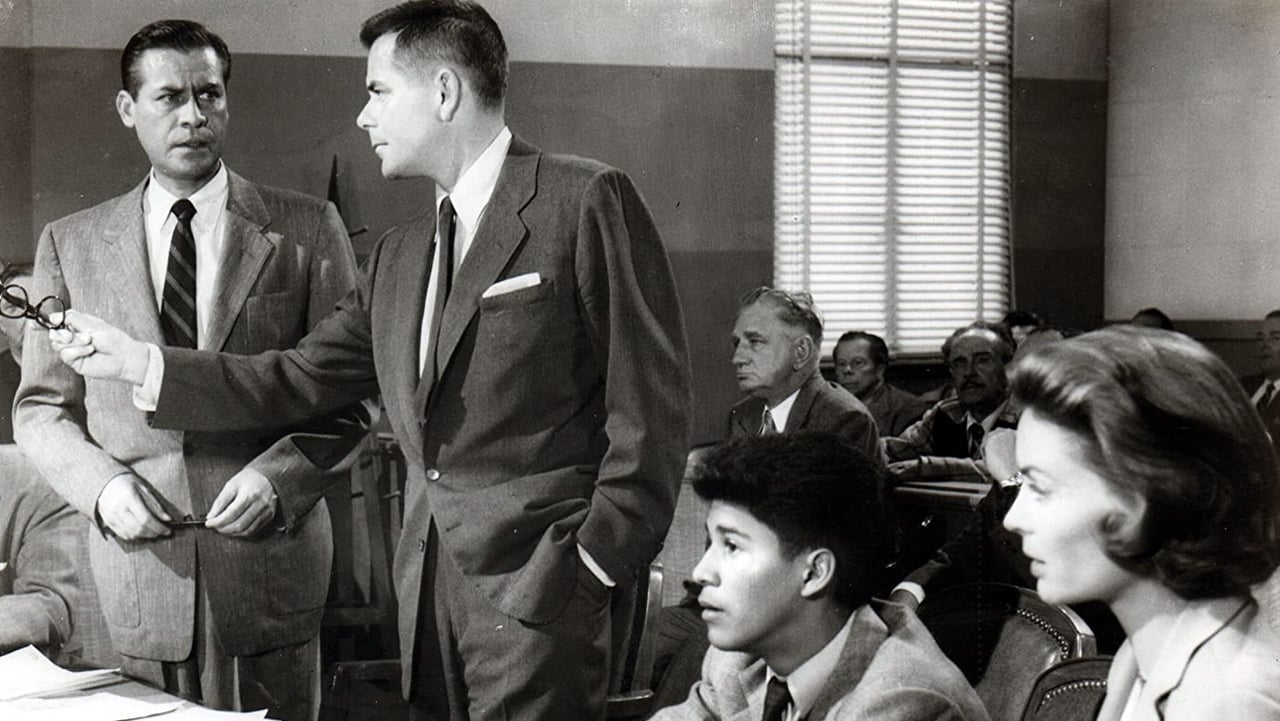
Trial (1955), directed by Mark Robson, starring Glenn Ford and Dorothy McGuire.
score
Tense! Timely! Thrilling!
Synopsis
A Mexican boy accused of rape and murder becomes a pawn for Communists and red-baiters. A courtroom drama set in 1947 and underlying post-WW2 acute problems facing the USA such as stormy race relations and the growing threat of local communism.
- Robert SurteesCinematography
- Mark RobsonDirector
- Albert AkstEditing
- Charles SchneeProducer
About the film
Trial is a 1955 American legal drama film directed by Mark Robson and starring Glenn Ford, Dorothy McGuire, and Arthur Kennedy. It features John Hodiak, Katy Jurado, Rafael Campos, and Juano Hernandez.
Adapted by Don Mankiewicz from his own novel of the same name, the story concerns the trial of a Mexican boy accused of rape and murder who is initially victimized by prejudiced accusers, and then becomes a pawn of his communist defender, whose propagandist purposes would be best served by a guilty verdict.
Read the full article (6k characters)
Trial is a 1955 American legal drama film directed by Mark Robson and starring Glenn Ford, Dorothy McGuire, and Arthur Kennedy. It features John Hodiak, Katy Jurado, Rafael Campos, and Juano Hernandez.
Adapted by Don Mankiewicz from his own novel of the same name, the story concerns the trial of a Mexican boy accused of rape and murder who is initially victimized by prejudiced accusers, and then becomes a pawn of his communist defender, whose propagandist purposes would be best served by a guilty verdict.
Plot
On the evening of June 7, 1947, residents of the small California town of San Juno are celebrating an annual event called Bass Night at a local private beach. Angel Chavez, a Mexican-American teenager, wanders onto the beach and meets Marie Wiltse, a non-Hispanic girl he knows from high school, and the pair begin to kiss. Marie, whose heart has been weakened by rheumatic fever, gets nervous and starts to leave, but she suddenly collapses and dies. Angel calls out for help and is promptly arrested and charged with felony murder on the grounds that Marie's death was caused by his attempt to seduce her—which, as they are minors, would be statutory rape, even if consensual.
David Blake is a law professor at State University who is told his contract will not be renewed unless he gets some courtroom experience. After being rejected by a number of alumni of the college, Barney Castle agrees to let David work for him over the summer to handle Angel's case. The situation in San Juno is volatile, and a racist mob attempts to break Angel out of jail and lynch him, but the sheriff persuades them to stop by promising the youth will be executed after a fair trial.
Castle and Angel's mother travel to New York City to raise money to defend Angel. Castle leaves his secretary Abbe Nyle to help Blake, and they fall in love. Detectives working for Castle's firm uncover an attempt to tamper with the jury on behalf of the prosecution, resulting in a new jury being empaneled. Over a weekend break during jury selection, Castle calls Blake to New York to join him at a fundraising rally. Blake quickly realizes Castle is primarily using the case as a propaganda and fundraising tool for an American Communist group. Insulted at being used, he returns to San Juno to see the trial through to the end and represent Angel's interests.
Blake's trial strategy is to rebut the prosecution's case sufficiently that he does not need to present a defense. However, at the last moment, Castle returns and, using his influence on Angel's mother, threatens Blake with removal unless Angel testifies. Although Blake realizes that Castle wants Angel subjected to a harsh cross-examination that will ensure his conviction and execution—making him a martyr with ongoing fundraising value—he remains on the case, but the cross-examination goes as poorly as he feared. Angel is found guilty, and, since the jury did not recommend leniency, he must receive a death sentence.
Castle fires Blake to keep him from speaking during sentencing, but Blake shows up at court anyway and receives amicus status, allowing him to address the court. He argues that, since Chavez is a minor, Judge Motley can technically apply a statute intended for more trivial offenses and give Angel an indeterminate sentence to be spent at a reform school. With the consent of the prosecutor, Motley accepts the suggestion. Then Motley, who is African-American, sentences Castle, who has tried to race-bait him during Blake's argument, to 30 days in jail for contempt.
Cast
Production
Mankiewicz's novel won the 1954 "Harper's Prize" which included an award of $10,000 and a guarantee of publication by Harper's Publishing. He also received $25,000 from MGM for the screen rights and was hired to write the film adaptation. Mankiewicz softened the story's ending for the film and developed the love story.
Principal photography and post-production for Trial took place from early April through May 16, 1955.
The scene depicting a rally in New York City was filmed over three days in Los Angeles's Shrine Auditorium and cost $110,000. Two thousand extras were used, including 750 students from the nearby University of Southern California.
Production Code concerns
Executives at MGM were concerned that the film's script might be seen as a "subtle Communist vehicle" because of negative remarks made in the story about Senator Battle's zealous anti-Communist campaign, and the sympathetic manner in which the film dealt with a former Communist Party member, the ex-lover of the protagonist. Despite these concerns, the Production Code Administration made no objections to that material and was more concerned that the film implied that the unmarried David and Abbe spent the night together, and that they had previously had an affair. All of this material remained in the film as released.
Reception
Critical response
The film received generally positive reviews, with praise for its depiction of contemporary race relations and its "historical significance". The Hollywood Reporter wrote that "every American should see it," but also "every European" since it would "prove...that Americans, in their approach to history, are not stupid, not children, and not naïve."
The review in Daily Variety suggested that if D. W. Griffith's 1915 film The Birth of a Nation, which lionized the Ku Klux Klan, "was the Negro race's greatest misfortune," then Trial might be its "greatest break in terms of a fully felt, many-sided, warm human being", praising the depiction of Judge Motley, an African American, as a "notable advance" in the presentation of Black characters.
Box office
According to MGM records, the film earned $2,312,000 in the U.S. and Canada, and $993,000 elsewhere, resulting in a profit of $518,000.
Awards and honors
See also
List of American films of 1955
References
External links
Trial at IMDb
Trial at the TCM Movie Database (archived)
Trial at the AFI Catalog of Feature Films
Text from Trial (film) on Wikipedia, licensed CC BY-SA 4.0. https://en.wikipedia.org/wiki/Trial_(film)
Trivia
- It premiered on October 7, 1955, a Friday.
- It runs 1h49 — a typical feature length.
- It won 0 award(s) and received 1 nomination(s) on record at Wikidata — Academy Award for Best Supporting Actor among them.
- As of September 20, 2026, it is available in Brazil by subscription on Looke.
- This film's quiz has 12 questions — enough to play more than once without repeats.
Production
- StudiosMetro-Goldwyn-Mayer
- CountriesUnited States
- LanguagesEnglish
- StatusReleased
More about this film
Nominations
- Academy Award for Best Supporting Actor 1956
Set in
- New York City
- California
Where to watch
Photos
Cast
-
 Glenn Ford
David Blake
Glenn Ford
David Blake -
 Dorothy McGuire
Abbe Nyle
Dorothy McGuire
Abbe Nyle -
 Arthur Kennedy
Barney Castle
Arthur Kennedy
Barney Castle -
 John Hodiak
District Attorney John J. Armstrong
John Hodiak
District Attorney John J. Armstrong -
 Katy Jurado
Consuela Chavez
Katy Jurado
Consuela Chavez -
 Rafael Campos
Angel Chavez
Rafael Campos
Angel Chavez -
 Juano Hernández
Judge Theodore Motley
Juano Hernández
Judge Theodore Motley -
 Robert Middleton
A.A. "Fats" Sanders
Robert Middleton
A.A. "Fats" Sanders -
 John Hoyt
Ralph Castillo
John Hoyt
Ralph Castillo -
 Paul Guilfoyle
Cap Grant
Paul Guilfoyle
Cap Grant -
 Elisha Cook Jr.
Finn
Elisha Cook Jr.
Finn - Ann Lee Gail Wiltse
-
 Whit Bissell
Sam Wiltse
Whit Bissell
Sam Wiltse -
 Richard Gaines
Dr. Johannes Schacter
Richard Gaines
Dr. Johannes Schacter -
 Barry Kelley
Jim Brackett
Barry Kelley
Jim Brackett -
 Dorothy Green
Mrs. Mary Ackerman (uncredited)
Dorothy Green
Mrs. Mary Ackerman (uncredited) -
 Frank Cady
Canford (uncredited)
Frank Cady
Canford (uncredited) -
 Percy Helton
Youval (uncredited)
Percy Helton
Youval (uncredited) - Robert Stevenson Reporter (uncredited)
Quiz about this movie
Questions from the whole catalogue.
Play nowIf you liked this one
-
O Sol é Para Todos
 8.0
8.0
-
Contra o Império do Crime
 6.6
6.6
-
O Homem Errado Drama from the 1950s
 7.1
7.1
-
O Ódio é Cego Drama from the 1950s
 6.9
6.9
-
O Crime Não Compensa
 6.2
6.2
-
Filadélfia
 7.7
7.7
-
Um Dia Desses
 7.0
7.0
-
Um Ato de Esperança
 6.6
6.6
-
Trágica Fatalidade Drama from the 1950s
 6.5
6.5
-
Lowriders : A Arte nos Carros
 6.7
6.7
-
O Conde de Monte Cristo
 6.9
6.9
-
O Beco das Almas Perdidas
 7.2
7.2
Tags
Crew
- Robert Surtees Cinematography
- Mark Robson Director
- Albert Akst Editing
- Charles Schnee Producer
- Daniele Amfitheatrof Original music
- Don Mankiewicz Writer
Questions about this film
What is Trial about?
Trial: A Mexican boy accused of rape and murder becomes a pawn for Communists and red-baiters. A courtroom drama set in 1947 and underlying post-WW2 acute problems facing the USA such as stormy race relations and the growing threat of local communism.
Who directed Trial?
Trial was directed by Mark Robson in 1955.
Who stars in Trial?
The cast of Trial includes Glenn Ford, Dorothy McGuire, Arthur Kennedy, John Hodiak and Katy Jurado.
How long is Trial?
Trial runs for 109 minutes, or 1h49.
Where can I watch Trial?
Trial is available on Looke and Looke Amazon Channel. Availability changes often: the list on this page is the most recent we received.
Similar films
 8.7
8.7
 8.5
8.5
 8.7
8.7
 7.9
7.9
 8.4
8.4
 8.5
8.5
 8.1
8.1
 8.2
8.2
 8.0
8.0
 8.2
8.2
 8.5
8.5
 8.5
8.5
Page updated on 09/18/2026.
Back to the catalogue