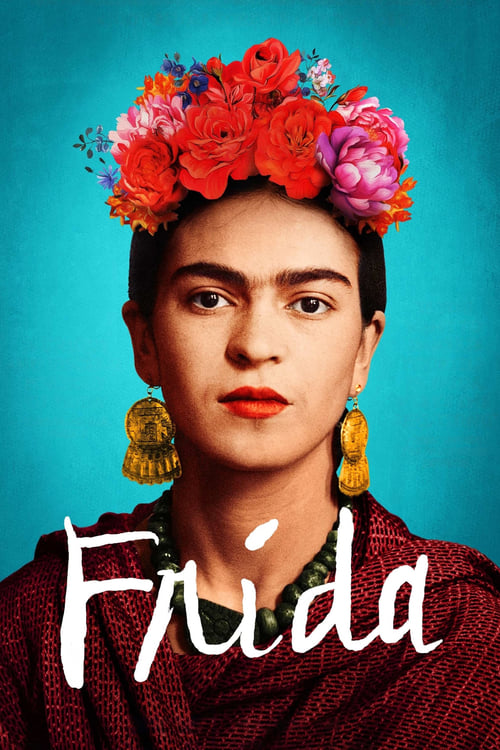


Frida (2024)
Frida (2024), directed by Carla Gutierrez, starring Frida Kahlo and Fernanda Echevarría.
score
Her truth. Her art. Her words.
Synopsis
An intimately raw and magical journey through the life, mind, and heart of iconic artist Frida Kahlo. Told through her own words for the very first time — drawn from her diary, revealing letters, essays, and print interviews — and brought vividly to life by lyrical animation inspired by her unforgettable artwork.
- Carla GutierrezDirector, Editing
- Alexandra JohnesProducer
- Justin WilkesProducer
- Katia MaguireProducer
About the film
Frida is a 2024 documentary film directed by Carla Gutierrez about the life of Mexican painter Frida Kahlo. As Gutierrez's directorial debut, it was first shown at the 2024 Sundance Film Festival where it won the U.S. Documentary Jonathan Oppenheim Editing Award.
Read the full article (9k characters)
Frida is a 2024 documentary film directed by Carla Gutierrez about the life of Mexican painter Frida Kahlo. As Gutierrez's directorial debut, it was first shown at the 2024 Sundance Film Festival where it won the U.S. Documentary Jonathan Oppenheim Editing Award.
Premise
Through her own writings and interviews, as well as brand-new animation, Kahlo chronicles and addresses her entire life and career from a first-person perspective. Many of the most pivotal and formative moments of her life are mentioned and/or detailed, such as her devastating accident as a passenger of a trolley car, her complicated relationship with the fellow Mexican painter Diego Rivera, her time spent in cities like New York City and Detroit, and her affair with the Russian revolutionary Leon Trotsky. Both animation and sound design are leveraged to further depict the complexity of Kahlo's psyche, making for a visceral and intimate look at her vast and changing senses of human desire, the state of the world in the twentieth century, and her own artistry. With a rich body of archival material with primary relevance and association with Kahlo, such as her own works as well as correspondences from her loved ones, a multifaceted and dynamic look at Kahlo's life and legacy appears.
Production
Long before Frida was conceived, Gutierrez noticed the abundance of existing writing from the Mexican painter yet not a narrative told from her own words. She then approached Julie Cohen and Betsy West, the directors of RBG and Julia, for insight on how to make a larger-than-life documentary about a female icon. While some studios found the prospect of a Spanish-only film to be daunting, especially with its experimental elements in visuals and sounds, a few distributors eventually took on Gutierrez's vision for a directorial debut: a documentary sourced from Kahlo's own words.
The film draws upon many multimedia elements, including but not limited to voice acting, animation, and restoration of materials in old and antiquated formats. The words of Kahlo herself, taken from her own writing, are narrated by Fernanda Echevarría, and Gutierrez worked with several animators based in Mexico to add a visual counterpart to her film's sound. To shape and inform the timeline of Kahlo's life and career, Gutierrez drew upon American historian Hayden Herrara's 1983 book Frida: A Biography of Frida Kahlo and directors Karen and David Crommie's 1976 The Life and Death of Frida Kahlo. With permission, Gutierrez was given access to Herrera's research which she had used for his book. In Herrera's attic, Gutierrez found a diversity of transcripts, writing, and other primary sources.
Outside of Herrera's own research, among the archival materials used for Frida were collections of the Hoover Institution Library and Archives. Much of the footage used, specifically at Kahlo's Blue House, was taken by American photographer Ivan Heisler, who also managed to capture footage of Kahlo's hospitable encounters with Trotsky. Just in time for showing at the Sundance Film Festival, the Hoover Institution remastered their footage to 4K to provide the best possible quality for Gutierrez. Additionally used were the papers of Bertram D. Wolfe, an American communist and friend of Rivera who personally held many photos of Kahlo and Rivera, several of which are seen in the film.
Release
The film won the Jonathan Oppenheim Editing Award in the U.S. documentary category at the 2024 Sundance Film Festival. Gutierrez explained that not only did she direct Frida, but she also significantly edited it herself using a wide variety of Adobe tools. Her own editing was joined by a diverse production team of sound designers, musicians, and animators who further added new dimensions to Frida's composition.
Reception
Many critics who watched Frida at the Sundance Film Festival in Park City, Utah found the documentary to be an ambitious attempt to depict Kahlo's life and career with both accuracy and novelty, though some were divided on whether Gutierrez's idiosyncratic techniques of production, as well as the points of Kahlo's life which she chose to highlight, were effective. Specifically, the choice to animate some of Kahlo's self-portraits appeared divisive. For some critics, however, the film excelled in its faithfulness to Kahlo's story, its ingenuity of craft, and its wondrous contribution to the body of work dedicated to capturing the enormity of the Mexican painter's life. On the review aggregator website Rotten Tomatoes, the film has a rating of 90% and an average rating of 7.5/10, based on 48 critics' reviews. The consensus reads: "Using the artist's own words to tell her fascinating story, Frida is an absorbing documentary for novices and faithful fans alike."
Sheri Linden, for The Hollywood Reporter, said,Such razor-sharp perceptions and unapologetic pronouncements fuel Frida no less than the unsettling and beautiful images she conjured. Beyond the artistic pretensions she disdained, Kahlo noted that her canvases depicted her life, not the dreamscapes that were central to Surrealism. It was an exceptional life, and here at last is a film that not only honors her without resorting to sensationalism but that also lets her speak. At the end of Gutiérrez's fine film, you likely will feel the spell of a remarkable person's company.Writing for ARTnews, Maximilíano Durón said that "the film unfortunately tells the same story that has already been told about Kahlo, without providing much new material along the way, other than some kitschy animations of her paintings." However, Durón found the emphasis on Kahlo's words, which have historically been underrepresented in exhibits and other tributes, to be refreshing and a certain positive. Furthermore, Durón argued that Gutierrez's film needed to have a different orientation to Kahlo's politics, citing the film's lack of commentary on her belief in communism as well as a sparse account of her relationship to Trotsky. Regarding the Mexican Revolution, Durón said,To understand Kahlo and her art, it's crucial to view it against the backdrop of post-Revolution Mexico. She was born in 1907, three years before the Revolution began, but at a certain point in her life, she redated her birth to 1910 so that she arrived in the world along with the Revolution. At a time when the new Mexican government was fixated on constructing a national identity through the arts—look no further than the work of Los Tres Grandes, the painters David Alfaro Siqueiros, José Clemente Orozco, and her future husband, Diego Rivera—that is a significant detail, if not an essential one. Even if Kahlo was often dismissed as Rivera's wife or a second-tier Surrealist painter during her lifetime, she was just as committed to the cause of a new Mexico. That goes unmentioned in the film.Though he complimented the film's feats, Christian Zilko from IndieWire additionally remarked,While Kahlo's eloquence provides an excellent foundation for the film, it can be disappointing that her art isn't highlighted with the same prominence as her writing. Rather than show her actual paintings, the film relies on animated versions of them that bring her portraits to life. The execution is impressive, but it deprives viewers of the chance to see her work unvarnished while listening to her words. Perhaps the choice was made to add some motion into what otherwise could have been a static film that resembled a PowerPoint presentation. But there is something incomplete about a painting documentary that manipulates the actual work – especially when so much of the film's thesis rests on the idea that Kahlo deserves to be remembered on her own terms.
In comparison to past works depicting Kahlo, The Austin Chronicle's Austin Whitaker said,But while Frida is intriguing, and undoubtedly a good primer to the life, mind and work of the artist, it's still a little overshadowed by Julie Taymor's visually enthralling and Oscar-nominated Frida, and not as structurally daring as Ken Mandel's hybrid docudrama Frida Kahlo: A Ribbon Around a Bomb. Keeping the words of Kahlo and Rivera in the original Spanish adds a certain immediacy, but that narration is not always quite so effectively applied. American newspaper reports are recited in a ridiculous fake '30s radio voice (you know the one), and why exactly are the words of French poet André Breton and Belgian surrealist René Magritte presented in thickly-accented English?
Gallery
References
External links
Official website
Frida at IMDb
Text from Frida (2024 film) on Wikipedia, licensed CC BY-SA 4.0. https://en.wikipedia.org/wiki/Frida_(2024_film)
Trivia
- It premiered on March 8, 2024, a Friday.
- It runs 1h27 — a typical feature length.
- As of September 20, 2026, it is available in Brazil by subscription on Amazon Prime Video.
- This film's quiz has 10 questions — enough to play more than once without repeats.
Production
- StudiosImagine Documentaries, Storyville Films, TIME Studios, Imagine Entertainment
- CountriesUnited States
- LanguagesEnglish, Spanish
- StatusReleased
Where to watch
Videos
Cast
-
 Frida Kahlo
Self (archive footage)
Frida Kahlo
Self (archive footage) -
 Fernanda Echevarría
Narrator (Frida)
Fernanda Echevarría
Narrator (Frida) -
 Pablo Alarson
Self - Jean Van Heijenoort (voice)
Pablo Alarson
Self - Jean Van Heijenoort (voice) - Jeanne Albanese Self - Ella Wolfe (voice)
-
 Tizoc Arroyo
Self - Baltasar Dromundo (voice)
Tizoc Arroyo
Self - Baltasar Dromundo (voice) -
 Yeraldín Balcázar
Self - André Breton (voice)
Yeraldín Balcázar
Self - André Breton (voice) -
 Roberto Cavazos
Self - Bertram Wolfe (voice)
Roberto Cavazos
Self - Bertram Wolfe (voice) - Patricia Collazo Self - Adelina Zendejas (voice)
- Lindsay Conklin Self - Lucile Blanch (voice)
Quiz about this movie
Questions from the whole catalogue.
Play nowIf you liked this one
-
Embaixo da Luz de Neon Documentary from the 2020s
 7.2
7.2
-
Tupac: Resurrection
 7.9
7.9
-
Jayne Mansfield, Minha Mãe Documentary from the 2020s
 8.0
8.0
-
Jennifer Lopez: Halftime Documentary from the 2020s
 6.8
6.8
-
Com Amor, Antosha
 7.4
7.4
-
Everybody’s Everything
 8.4
8.4
-
Alexandre McQueen
 7.4
7.4
-
Serei Amado Quando Morrer
 7.1
7.1
-
Amor Tóxico Documentary from the 2020s
 6.4
6.4
-
Supersonic
 7.4
7.4
-
Audrey Documentary from the 2020s
 7.1
7.1
-
Gilbert
 6.7
6.7
Tags
Crew
- Carla Gutierrez Director
- Carla Gutierrez Editing
- Alexandra Johnes Producer
- Justin Wilkes Producer
- Katia Maguire Producer
- Loren Hammonds Producer
- Sara Bernstein Producer
- Víctor Hernández Stumpfhauser Original music
Questions about this film
What is Frida about?
Frida: An intimately raw and magical journey through the life, mind, and heart of iconic artist Frida Kahlo. Told through her own words for the very first time — drawn from her diary, revealing letters, essays, and print interviews — and brought vividly to life by lyrical animation inspired by her unforgettable artwork.
Who directed Frida?
Frida was directed by Carla Gutierrez in 2024.
Who stars in Frida?
The cast of Frida includes Frida Kahlo, Fernanda Echevarría, Pablo Alarson, Jeanne Albanese and Tizoc Arroyo.
How long is Frida?
Frida runs for 87 minutes, or 1h27.
Where can I watch Frida?
Frida is available on Amazon Prime Video and Amazon Prime Video with Ads. Availability changes often: the list on this page is the most recent we received.
Similar films
-
 7.3
7.3
Harry Potter 20th Anniversary: Return to Hogwarts
2022
-
 6.3
6.3
Jackass: The Movie
2002
-
 7.5
7.5
The Social Dilemma
2020
-
 6.7
6.7
Super Size Me
2004
-
 7.5
7.5
Bowling for Columbine
2002
-
 7.9
7.9
Free Solo
2018
-
 6.6
6.6
Jackass 3D
2010
-
 7.1
7.1
Fahrenheit 9/11
2004
-
 7.8
7.8
Friends: The Reunion
2021
-
 7.7
7.7
Citizenfour
2014
-
 6.6
6.6
Jackass Number Two
2006
-
 7.6
7.6
Amy
2015
Page updated on 09/14/2026.
Back to the catalogue