


Death Note (2006)
The human whose name is written in this note shall die.
Synopsis
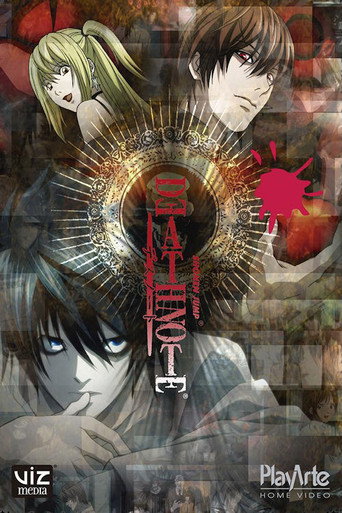
Light Yagami is an ace student with great prospects—and he’s bored out of his mind. But all that changes when he finds the Death Note, a notebook dropped by a rogue Shinigami death god. Any human whose name is written in the notebook dies, and Light has vowed to use the power of the Death Note to rid the world of evil. But will Light succeed in his noble goal, or will the Death Note turn him into the very thing he fights against?
About the series
Death Note (stylized in all caps) is a Japanese anime television series based on the manga series Death Note, written by Tsugumi Ohba and illustrated by Takeshi Obata. It was directed by Tetsurō Araki at Madhouse and aired in Japan on Nippon Television every Wednesday (with the exception of December 20, 2006, and January 3, 2007) shortly past midnight, from October 4, 2006, to June 27, 2007. The plot of the series primarily revolves around high school student Light Yagami, who decides to rid the world of evil with the help of a supernatural notebook called a Death Note. This book causes the death of anyone whose name is written in it and is passed on to Light by the Shinigami Ryuk after he becomes bored within the Shinigami world.
A two-hour "Director's Cut" compilation television film, titled Death Note: Relight – Visions of a God, aired on Nippon Television two months after the anime series concluded. Although advertised to be the "complete conclusion", the popularity of the series inspired the release of a second TV film, titled Death Note: Relight 2 – L's Successors nearly a year later. These films summarize the first two parts of the series' narrative, but they alter the plot by adding and omitting scenes.
Read the full article (11k characters)
Death Note (stylized in all caps) is a Japanese anime television series based on the manga series Death Note, written by Tsugumi Ohba and illustrated by Takeshi Obata. It was directed by Tetsurō Araki at Madhouse and aired in Japan on Nippon Television every Wednesday (with the exception of December 20, 2006, and January 3, 2007) shortly past midnight, from October 4, 2006, to June 27, 2007. The plot of the series primarily revolves around high school student Light Yagami, who decides to rid the world of evil with the help of a supernatural notebook called a Death Note. This book causes the death of anyone whose name is written in it and is passed on to Light by the Shinigami Ryuk after he becomes bored within the Shinigami world.
A two-hour "Director's Cut" compilation television film, titled Death Note: Relight – Visions of a God, aired on Nippon Television two months after the anime series concluded. Although advertised to be the "complete conclusion", the popularity of the series inspired the release of a second TV film, titled Death Note: Relight 2 – L's Successors nearly a year later. These films summarize the first two parts of the series' narrative, but they alter the plot by adding and omitting scenes.
Cast and characters
Production
Tetsurō Araki, the director of the anime series, said that he wished to convey aspects that "made the series interesting" instead of simply "focusing on morals or the concept of justice". Toshiki Inoue, the series writer, agreed with Araki and added that, in anime adaptations, there is a lot of importance in highlighting the aspects that are "interesting in the original". He concluded that Light's presence was "the most compelling" aspect; therefore the adaptation chronicles Light's "thoughts and actions as much as possible". Inoue noted that to best incorporate the manga's plot into the anime, he "tweak[ed] the chronology a bit" and incorporated flashbacks that appear after the openings of the episodes; he said this revealed the desired tensions. Araki said that, because in an anime the viewer cannot "turn back pages" in the manner that a manga reader can, the anime staff ensured that the show clarified details. Inoue added that the staff did not want to get involved with every single detail, so the staff selected elements to emphasize. Due to the complexity of the original manga, he described the process as "definitely delicate and a great challenge". Inoue admitted that he placed more instructions and notes in the script than usual. Araki added that because of the importance of otherwise trivial details, this commentary became crucial to the development of the series.
Araki said that when he discovered the Death Note anime project, he "literally begged" to join the production team; when he did join, he insisted that Inoue should write the scripts. Inoue added that, because he enjoyed reading the manga, he wished to use his effort.
Release
The Death Note anime television series, directed by Tetsurō Araki and animated by Madhouse, premiered on Nippon Television on October 4, 2006, and concluded on June 27, 2007, running for a total of 37 episodes. The series aired every Tuesday at 0:56, which is effectively every Wednesday at 12:56 a.m. JST. It was produced by a production committee consisting of Nippon Television, D.N. Dream Partners, VAP, Shueisha and Madhouse. In North America, the series was licensed by Viz Media for American viewers to use "Download-to-Own" and "Download-to-Rent" services while it was still airing in Japan. This release was seen as "significant because it marked the first time a well known Japanese anime property was made legally available in the United States for domestic audiences to download while the title was still airing on Japanese television". The downloadable episodes contained the original Japanese audio and English subtitles, and were made available through IGN's Windows-only Direct2Drive service. DVDs of the series have also been released, containing both an English dubbed audio track, produced by Ocean Productions, and the original Japanese audio track with optional English subtitles. Viz announced at Anime Expo 2007 that the first DVD would be released on November 20, 2007, in both regular and special editions, and also confirmed at San Diego Comic-Con in 2007 that the first 15,000 copies of each DVD would contain collectible figures.
Death Note was originally slated to make its North American television premiere in Canada, as part of YTV's Bionix programming block, on September 7, 2007. However, the show was removed from the schedule at the last minute and the Canadian premiere was pushed back to October 26, 2007, at 10:00 p.m. Thus, it instead premiered in the United States on October 20, 2007, on Cartoon Network's nighttime programming block Adult Swim and reran until January 10, 2010, when the syndication license expired. The last episode premiered on YTV on July 4, 2008, and would later premiere on Adult Swim two days later. The show also streamed online for free on Adult Swim Video, with a new episode available every Saturday afternoon, on the day of its broadcast premiere. On July 26, 2017, Starz announced that they would be offering episodes of the series for their video on demand service starting on August 1 of that same year.
An animated two-hour compilation TV film titled Death Note Relight: Visions of a God (DEATH NOTE リライト・幻視する神, Desu Nōto Riraito: Genshisuru Kami) aired on Nippon Television in Japan on August 31, 2007, at 8:00 p.m. It is a recap which takes place after the series end, where a shinigami approaches Ryuk in the shinigami realm in order to learn more about the human world. Instead, Ryuk tells him of all the events leading up to the final story arc, about Light Yagami and his rival L. Originally, this special was advertised as a retelling told from Ryuk's point of view, but it does not give a different point of view from what was originally told. However, it does contains updated dialogue, as well as a few additional scenes not featured in the original series run.
Nippon Television also aired a second compilation film titled Death Note: Relight: L's Successors (DEATH NOTE リライト2 Lを継ぐ者, Desu Nōto Riraito 2: L o Tsugu Mono) on August 22, 2008. Like the first film, this compilation summarizes the second part of the anime series. Specifically, it recounted the final half of the suspenseful supernatural story, including the investigators Near and Mello's confrontations with the vigilante Kira. This version features more scene additions than the previous film and omits the mafia subplot.
Tropics Entertainment licensed the series in South and Southeast Asia for streaming on its Tropics Anime Asia YouTube Channel, releasing each episode daily from August 1 to September 6, 2026.
Episodes
Part I
Part II
Relight TV films
Home media release
Japanese
English
Music
Five pieces of theme music are used for the series. The first opening theme, titled "The World", is performed by Nightmare. Nightmare also performed the first ending theme, "Alumina" (アルミナ, Arumina), which reappears as the ending theme in the television film Death Note: Relight: Visions of a God and as an insert in episodes 12 and 19. Both songs appear on their album The World Ruler. The second opening theme from episode 20 onwards is "What's Up, People?!" and the second ending theme is "Zetsubō Billy" (絶望ビリー, Zetsubō Birī; "Desperate Billy"), which also appears as an insert in the TV special Death Note: Relight: Visions of a God. Both themes are performed by Maximum the Hormone and appear on their album Bu-ikikaesu. The final episode's ending theme is "Coda – Death Note" by series co-composer Yoshihisa Hirano. "Misa's Song", performed by Misa's voice actress Aya Hirano, is heard as an insert for episode 25. The English version of the song is performed by the character's English voice actress, Shannon Chan-Kent.
Several soundtracks for the series have been released. The music from the anime was composed by Yoshihisa Hirano and Hideki Taniuchi, while the CDs were also published by VAP. The first one was Death Note Original Soundtrack, which was released in Japan on December 21, 2006. It contains music from the series with the first opening and ending themes are sung by the Japanese band Nightmare in the TV size format. Death Note Original Soundtrack II was first released in Japan on March 21, 2007. It features the new opening and closing themes by Maximum the Hormone in the TV size format. The third CD, Death Note Original Soundtrack III was released on June 27, 2007. Tracks 1–21 were composed and arranged by Taniuchi, while tracks 22–28 were composed and arranged by Hirano. The album features one track sung by Aya Hirano, who was also the Japanese voice actress of Misa Amane in the anime series. Also appearing on this soundtrack is the ending theme Coda – Death Note, which can be heard at the end of the final episode of the anime as the credits are shown.
Reception
On the review aggregator website Rotten Tomatoes, 100% of 14 critics' reviews are positive, with an average rating of 8.5/10. The website's consensus reads: "Death Note is an exceptional anime that poses profound questions about justice and murder, all while delivering a supremely satisfying tale of tactical one-upmanship between a detective and killer."
The anime was commended by Tom S. Pepirium of IGN, who said that Death Note's "heavy serialized nature" is what "makes the show so engaging and discussion worthy". Pepirium, saying that translating Death Note is "no small task", stated that Stephen Hedley created an English dub with "nothing clunky". He added that Karl Willems, director of the dub, assembled a "stunning voice cast of professionals" with a "solid tone minus some of the cheesy yelling and screaming of other dubs". On the NPR show Fresh Air, John Powers said that Death Note is "at least as addictive as a show like Lost". Hyper wrote: Running over thirty-seven 20 minutes episodes, the anime sticks much closer to the manga so takes a far more languid approach to storytelling, better fleshing out the fantastic characters of Light and his nemesis, L. Light in particular is one of the most layered characters to appear in anime in a long time. Jacob Hope Chapman from Anime News Network praised Teru Mikami's role as bloody and flashy and even better than that of Near, Mello, and Misa. The Daily Telegraph's Henry St. Leger wrote, "What starts as a moral fable about the corruption of power becomes a slow-burning game of cat-and-mouse as Light is chased down by the world's greatest detective. Some droning voice acting leadens what is otherwise a brilliantly terse noir." Vulture's Maya Phillips wrote, "Beyond its deft twists and turns, Death Note also addresses questions about morality, justice, and capital punishment. All this, plus beautiful animation and well-written dialogue and plot, makes Death Note the cream of the animated crop."
The Death Note anime was one of the series to win Best TV Anime at the 2007 Tokyo International Anime Fair. In 2009, Death Note was ranked 51st in IGN's "Top 100 Animated Series" list.
Notes
References
External links
Official anime website (in Japanese)
Death Note (anime) at Anime News Network's encyclopedia
Death Note (2006) at IMDb
Text from Death Note (2006 TV series) on Wikipedia, licensed CC BY-SA 4.0. https://en.wikipedia.org/wiki/Death_Note_(2006_TV_series)
Seasons
-
Temporada 1 2006 · 37 episodes
Cast
-
Mamoru Miyano Light Yagami (voice)

-
Shido Nakamura Ryuk (voice)

-
Aya Hirano Misa Amane (voice)

-
Kappei Yamaguchi L (voice)

-
Kimiko Saito Rem (voice)

-
Naoya Uchida Soichiro Yagami (voice)

-
Ryou Naitou Touta Matsuda (voice)

-
Keiji Fujiwara Shuichi Aizawa (voice)

-
Kiyoshi Kobayashi Watari (voice)

-
Kazuya Nakai Kanzo Mogi (voice)

-
Noriko Hidaka Near (voice)

-
Nozomu Sasaki Mello (voice)

-
Tomohiro Nishimura Shibuimaru Takuo (voice)

-
Takeharu Onishi Gukku (voice)

-
Tetsuo Goto Deridovely (voice)

-
Ai Satou Sachiko Yagami (voice)

-
Haruka Kudou Sayu Yagami (voice)

-
Hideo Ishikawa Raye Penber (voice)

Where to watch
-
Netflix
Streaming
-
HBO Max
Streaming
-
Pluto TV
Free
-
Mercado Play
Free
Production
- StatusEnded
- NetworkNippon TV
- CountriesJapan
- titulo_originalDEATH NOTE
- First aired10/04/2006
- votes5,138
Crew
- Tomohiko Ito Director
- 米田光宏 Director
- Hiroyuki Tsuchiya Director
- 西映子 Director
- おゆなむ Director
- Shinji Nagamura Director
- Naoyasu Habu Director
- Tetsuro Araki Director
- Makoto Bessho Director
- 下田久人 Director
- Ryosuke Nakamura Director
- Takayuki Hirao Director
Tags
- Anime
- Arrogant
- Based on manga
- Death
- Detective
- Ethical dilemma
- Fantastic
- Grim reaper
- Horror
- Journalism
- Justice
- Magic book
- Murder
- Police
- Prosocial psychopath
- Psychological
- Psychological thriller
- Rivalry
- Secret identity
- Serial killer
Questions about the series Death Note
What is Death Note about?
Death Note: Light Yagami is an ace student with great prospects—and he’s bored out of his mind. But all that changes when he finds the Death Note, a notebook dropped by a rogue Shinigami death god. Any human whose name is written in the notebook dies, and Light has vowed to use the power of the Death Note to rid the world of evil…
How many seasons does Death Note have?
Death Note has 1 season, with 37 episodes in total.
Is Death Note still running?
Death Note has ended in 2007.
How long is each episode of Death Note?
Each episode of Death Note runs about 22 minutes.
Where can I watch Death Note?
Death Note is available on Netflix, HBO Max, Pluto TV and Mercado Play. Availability changes often.
Who stars in Death Note?
The cast of Death Note includes Mamoru Miyano, Shido Nakamura, Aya Hirano, Kappei Yamaguchi and Kimiko Saito.
Which country is Death Note from?
Death Note is a J-drama, produced in Japan.
Similar dramas
-
 8.1
8.1
Re:ZERO -Starting Life in Another World-
2016
-
 8.3
8.3
Elfen Lied
2004
-
 8.5
8.5
Steins;Gate
2011
-
 8.3
8.3
The Promised Neverland
2019
-
 8.6
8.6
Toilet-Bound Hanako-kun
2020
-
 8.1
8.1
Tower of God
2020
-
 7.9
7.9
Blue Exorcist
2011
-
 8.2
8.2
Serial Experiments Lain
1998
-
 8.1
8.1
Gleipnir
2020
-
 8.2
8.2
Bungo Stray Dogs
2016
-
 7.8
7.8
Black Butler
2008
-
 7.7
7.7
Ergo Proxy
2006
Trivia
- It premiered on October 4, 2006 and the last episode aired on June 27, 2007 — 1 years on air.
- It has 1 season(s) and 37 episode(s) — about 37 per season.
- It originally aired on Nippon TV.
- It is a production from: Japan.
- This series' quiz has 8 questions.
Page updated on 09/13/2026.